
The landscape of professional video production has undergone a fundamental transformation where the traditional barriers between amateur creators and professional studios have effectively dissolved through the integration of neural networks. Manual frame-by-frame manipulation, once the grueling and expensive bottleneck of the media industry, is rapidly yielding to a suite of automated workflows that prioritize creative intent over technical endurance. This shift represents more than just a software update; it is a complete reimagining of the digital production pipeline. By utilizing machine learning algorithms and sophisticated diffusion models, modern editors can now bypass the most tedious aspects of post-production. The context of this shift is rooted in the transition from static, linear editing to dynamic, intelligent systems that can predict movement and reconstruct environments.
This democratization of high-end production is particularly relevant in the current technological climate, as social media platforms and digital marketing agencies demand a constant stream of high-quality visual content. Where independent filmmakers once required a dedicated visual effects team to achieve specific aesthetics, they now possess the ability to render complex sequences from a simple web browser. This review explores the core principles behind these advancements, detailing how automated workflows have become the engine of a more inclusive and efficient creative economy. The significance lies not just in the speed of delivery, but in the accessibility of high-caliber storytelling tools for individuals who previously lacked the capital to compete with established production houses.
The Evolution of AI-Enhanced Content Creation
The journey from rudimentary digital filters to deep-learning video synthesis marks one of the most rapid technological progressions in modern computing. At the heart of this evolution are diffusion models, which operate by learning to reverse a process of adding noise to data, eventually gaining the ability to generate entirely new images and frames from scratch. This technical foundation allows for a shift away from the manual “splicing” of clips toward a collaborative environment where the software understands the semantic meaning of the footage. Instead of merely seeing pixels, the AI recognizes depth, lighting, and human anatomy, allowing for adjustments that feel organic rather than synthetic.
In the broader technological landscape, this progress has significantly lowered the entry barrier for high-energy content creation. Digital marketing thrives on speed and relevance, and the ability to pivot creative assets in real-time has become a vital competitive advantage. By automating the mechanical aspects of filmmaking, such as syncing audio or stabilizing shaky footage through predictive analysis, these tools have allowed creators to focus on narrative structure and brand identity. This shift from technical operator to creative director is the defining characteristic of the new era in content production, where the limitations of hardware are replaced by the boundlessness of algorithmic potential.
Core Pillars of AI Video Manipulation
Generative AI and Surreal Imagery
The advent of text-to-video and image-to-video generation has directly addressed the “blank canvas” problem that has long plagued creators working with limited resources. By inputting abstract prompts, users can leverage diffusion models to transform conceptual ideas into high-fidelity animations that would be physically impossible or prohibitively expensive to film. This capability is not just about creating something new; it is about the precision with which the AI interprets artistic intent, adjusting frame rates and lighting to match the desired mood. These models have become so sophisticated that they can maintain temporal consistency, ensuring that objects do not warp or disappear between frames, a hurdle that previously limited the utility of early generative systems.
Furthermore, the rise of surreal, high-energy imagery has carved out a new niche in digital aesthetics. Brands are increasingly moving away from the “lived-in” look of traditional cinematography toward hyper-realistic, often dream-like visuals that command attention in crowded social feeds. This trend is driven by the AI’s ability to blend disparate elements—such as a desert landscape and an underwater environment—into a seamless, unified composition. The significance of this technology lies in its capacity to offer infinite variations of a single concept, allowing for rapid A/B testing in marketing campaigns and the exploration of visual styles that were once the exclusive domain of high-budget science fiction films.
Intelligent Object Removal and Inpainting
Beyond the creation of new imagery, the technology excels in what can be described as “invisible editing,” a process that relies heavily on intelligent object removal and inpainting. When a creator needs to clean a scene, the AI identifies the unwanted subject and tracks its movement across the three-dimensional space of the video. Unlike simple static patching, this process requires the software to understand the temporal flow of the background. Once the subject is identified, the system uses inpainting to realistically reconstruct the missing pixels by sampling from the surrounding environment and adjacent frames. This ensures that the texture, lighting, and shadows of the background remain consistent even after the primary distraction is deleted.
This technical achievement transforms the way travel vloggers and documentary filmmakers approach their craft. A crowded tourist spot can be transformed into a serene, empty landscape, and accidental intrusions into the frame can be corrected without the need for a reshoot. The complexity of this task cannot be overstated; it involves calculating the trajectory of camera movement and the shifting perspective of the background simultaneously. By automating this “grunt work,” AI allows editors to maintain the integrity of their vision without being penalized for environmental factors beyond their control. This level of control represents a peak in the intersection of computer vision and creative problem-solving.
Emerging Trends in Multimodal Content
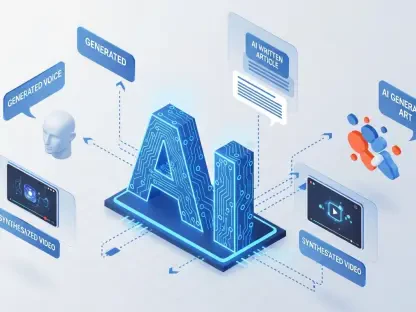
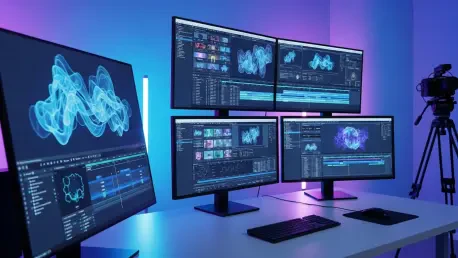
The current trajectory of video production is moving toward a multimodal approach where different types of data—text, audio, and visual—are processed simultaneously to create a cohesive output. One of the most striking developments is the rise of mathematically rich AI aesthetics, which often feature fluid transitions and high-contrast color palettes that feel distinctly modern. These visuals are increasingly being generated in browser-based environments, bypassing the need for expensive, localized hardware. This shift to the cloud allows for high-performance editing on standard consumer devices, as the heavy lifting of rendering and processing is handled by powerful remote server clusters.
Moreover, we are seeing a movement toward high-performance editing suites that integrate these multimodal capabilities into a single interface. These platforms allow creators to generate a script, produce a voiceover, and render a matching video sequence all within the same ecosystem. This convergence speeds up the production cycle by an order of magnitude, making it possible to produce topical content that reflects real-time trends. As these tools become more accessible, the distinction between “editing” and “generating” continues to blur, leading to a new standard of content that is highly personalized and optimized for the specific platform on which it will be viewed.
Real-World Applications Across Industries
In the commercial sector, the practical applications of AI video tools are manifest in the replacement of generic stock footage with custom-tailored visuals. Brands no longer need to settle for a clip that “roughly fits” their message; they can generate a specific scene that matches their color scheme and demographic targets perfectly. This level of customization has a direct impact on audience resonance, as viewers are more likely to engage with content that feels original and specifically crafted for them. Similarly, the travel industry has adopted removal tools to create idealized versions of destinations, helping to build an aspirational brand image that remains visually pristine despite the realities of global tourism.
Beyond aesthetic improvements, these tools are being deployed to enhance SEO and user retention metrics. Search engines prioritize content that keeps users on a page longer, and AI-enhanced videos with high production value are proven to increase dwell time. Additionally, the use of AI-generated thumbnails, which are optimized through predictive analytics to appeal to specific audience segments, has significantly boosted click-through rates. By analyzing which colors, compositions, and subjects perform best, creators can use AI to design the “entry point” of their content, ensuring that their work reaches the widest possible audience in an increasingly competitive digital landscape.
Current Technical and Ethical Hurdles
Despite the impressive progress, several technical hurdles remain, particularly regarding the pixel data requirements for high-resolution output. Generating 4K or 8K video in real-time requires immense computational power, and maintaining detail in complex textures like flowing water or human hair still presents challenges for even the most advanced models. Furthermore, there is the ongoing issue of “hallucinations,” where the AI may introduce artifacts or illogical movements into a scene. Creators often find that they must engage in iterative prompting, a process of refining their instructions multiple times to achieve a result that is both technically sound and artistically accurate.
Ethical considerations are equally prominent as the technology makes it easier to manipulate media with high fidelity. The challenge of maintaining authenticity in a landscape where any visual element can be added or removed is a significant concern for journalists and documentary filmmakers. To mitigate these risks, the industry is seeing a move toward using AI as a transparent collaborator rather than a hidden replacement. This involves the integration of digital signatures and clear labeling of AI-assisted content. Ongoing development efforts are focused on creating tools that assist human creativity while upholding a standard of truth, ensuring that the technology serves to enhance the human narrative rather than distorting it entirely.
The Future Landscape of Video Production
The trajectory of this technology points toward the potential for real-time generative environments, where sets and backgrounds can be altered instantly during the filming process. This would essentially eliminate the concept of “post-production” by allowing editors to make high-level creative decisions while the camera is still rolling. Furthermore, the total elimination of manual rotoscoping—a task that has been the bane of editors for decades—is within reach as AI becomes more adept at recognizing 3D depth and object boundaries. Breakthroughs in AI-driven color grading will also allow for the automatic matching of visual styles across disparate clips, ensuring a cinematic look regardless of the camera used.
Long-term, the democratization of Hollywood-level production standards will likely result in a surge of independent high-quality content. As the technical barriers continue to fall, the value of a production will be measured strictly by the strength of its story and the uniqueness of its vision. We may see a future where personalized films or interactive narratives are generated on the fly for individual viewers based on their preferences. This move toward hyper-customization and real-time rendering will redefine the relationship between the creator and the audience, turning passive consumption into a more dynamic and tailored experience that was previously unimaginable.
Final Assessment of AI Integration
The transition from manual labor to creative oversight represents the most significant shift in media production since the move from film to digital. AI video editing tools have proven to be more than just a passing trend; they are the new foundation for a more efficient and visually ambitious creative industry. The ability to generate complex imagery and remove unwanted elements with high precision has empowered a new generation of creators to produce work that rivals the quality of major studios. This evolution has directly contributed to a more vibrant digital ecosystem, where organic traffic and user engagement are driven by the high standard of visual storytelling that these tools provide.
The integration of artificial intelligence into the editing suite was a move that prioritized the human element of storytelling by removing the mechanical obstacles to expression. Creators who adopted these technologies early found that they were able to scale their output without compromising on the quality of their vision. In the end, the technology served to bridge the gap between imagination and execution, proving that the most powerful tool in any editor’s arsenal remains their own creativity. The era of manual frame manipulation has passed, leaving behind a landscape where the only limit to what can be produced is the breadth of the creator’s intent.