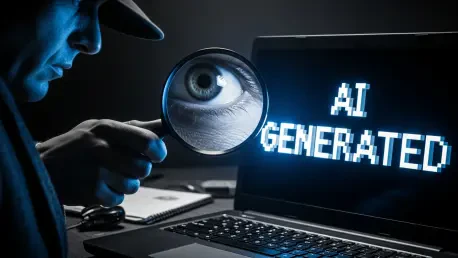

In the sprawling, chaotic digital landscape of 2025, where distinguishing between human creativity and machine-generated artifice has become a daily challenge for billions of social media users, a new type of digital figure has emerged not to sell products, but to sell the truth. These are the AI detectives, a growing cohort of influencers who are building massive followings by teaching the public how to spot the fakes flooding their feeds. As they arm their audiences with critical thinking tools, they are not only responding to a crisis of authenticity but are also fundamentally questioning what it means to be influential in an increasingly synthetic world. Their rise forces a critical examination of an online ecosystem teetering on the edge of a new reality, one where the most valuable skill may no longer be creating content, but verifying it.
A Crisis of Authenticity in the Digital Age
The modern internet is drowning in a deluge of synthetic content. Social media platforms, once heralded as spaces for genuine connection, are now inundated with algorithmically generated images, videos, and text that blur the line between real and fake. This constant exposure has cultivated a deep-seated skepticism among users, who now approach their feeds with a layer of distrust. The ease with which artificial media can be produced has led to an environment where every viral clip and stunning photograph is met with suspicion, eroding the foundational trust that underpins digital communities.
This erosion of trust poses a direct threat to the traditional “authenticity economy” that has fueled the multi-billion-dollar influencer industry for over a decade. That economy was built on the perceived genuineness of creators who shared their lives and recommendations with loyal followers. As AI becomes capable of perfectly mimicking human expression and creativity, the central question becomes unavoidable: Who can be trusted as an arbiter of truth? This challenge shifts the entire paradigm of influence, suggesting that the power may soon belong not to those who create the most compelling content, but to those who can most reliably prove its authenticity.
The Genesis of the Grassroots AI Detective
The explosive proliferation of generative AI tools has democratized the creation of digital media on an unprecedented scale. This surge is responsible for the circulation of over a billion AI-generated videos on platforms like TikTok alone, ranging from harmless, low-quality “AI slop” to highly sophisticated deepfakes designed to deceive. This sheer volume has overwhelmed the average user’s ability to discern reality from fiction, creating an urgent and widespread need for new forms of digital literacy. The technology advanced far more quickly than the public’s capacity to understand its implications, leaving a critical knowledge gap.
It was within this gap that the grassroots AI detective emerged. Responding to a clear market demand, a new class of influencers began dedicating their channels to media forensics. These “AI spotters” recognized that as the digital world grew more confusing, clarity and education would become a valuable commodity. They stepped in to serve as guides, translating the complex and often intimidating world of AI into practical, accessible knowledge for the masses. Their rapid growth in popularity demonstrates a collective desire among audiences to reclaim a sense of agency and certainty in a disorienting media environment.
Unmasking the Machine The AI Detectives Playbook
At the forefront of this movement are creators like Jeremy Carrasco, a prominent TikTokker who has transformed the niche skill of AI detection into a viral content category. Instead of showcasing a curated lifestyle, Carrasco dissects viral videos, pointing out the subtle digital fingerprints left behind by generative algorithms. His content is both a performance and a public service, turning the act of verification into an engaging and educational spectacle. By doing so, he and others like him are not just accumulating views; they are actively building a more discerning and critical audience, one follower at a time.
This new form of influence is rooted in empowerment. The goal is not simply to label content as “real” or “fake” but to equip viewers with the cognitive tools to make those judgments for themselves. By revealing his methods, Carrasco invites his audience into the analytical process, fostering a community of active participants rather than passive consumers. This educational approach builds a unique kind of trust, one based on shared knowledge and a mutual commitment to navigating the digital world with greater awareness.
From Complex Tech to Viral Content
The genius of the AI detective lies in the ability to distill highly technical concepts into easily digestible and shareable content. These creators serve as translators, breaking down the complex science behind generative models, pixel analysis, and metadata into simple, practical tutorials. They have mastered the art of blending entertainment with education, packaging crucial digital literacy lessons in the fast-paced, visually driven format that thrives on platforms like TikTok and Instagram Reels. This makes learning about AI forensics feel less like a lecture and more like solving a compelling mystery.
This approach effectively democratizes a skill set that was once the exclusive domain of tech experts and digital forensic analysts. By making this knowledge accessible, AI literacy influencers are enabling millions of people to become more savvy consumers of online media. They are creating a viral curriculum for the digital age, proving that educational content can compete with and even surpass traditional entertainment when it addresses a genuine and pressing public need.
A Practical Guide to Spotting Fakes
The playbook used by these digital sleuths focuses on teaching audiences to spot the subtle imperfections that often betray AI-generated content. Their tutorials provide a checklist of tell-tale signs, empowering viewers to become detectives themselves. These lessons often highlight unnatural or jittery eye movements in video subjects, as human ocular motion remains one of the most difficult things for AI to replicate flawlessly. They also train their followers to look for pixel-level inconsistencies or artifacts, especially around the edges of objects or in complex textures like hair and fabric.
Furthermore, these practical guides delve into more nuanced indicators of artificiality. Creators teach their audiences to scrutinize lighting and shadows, as AI models frequently struggle to render them in a way that is consistent with the physical laws of the environment. Background anomalies, such as warped lines or melting objects, are another common giveaway. Finally, they instruct viewers to pay close attention to flawed audio synchronization, where the movement of a subject’s lips does not perfectly match the spoken words, offering a clear clue that the content has been manipulated.
Forging a New Standard of Digital Trust
What distinguishes AI literacy influencers from their traditional counterparts is the core value they offer. While most influencers build their brands around aspiration—a lifestyle, a look, or a set of products—AI detectives build their brand around a skill. Their primary product is not content itself, but the critical thinking needed to evaluate all content. This represents a fundamental inversion of the influencer model, where the creator’s role shifts from being the subject of admiration to being a facilitator of understanding and empowerment for their audience.
This shift has profound implications for the creator-consumer power dynamic. By arming their followers with the ability to verify authenticity, these influencers are fostering a more equitable relationship. The audience is no longer just a passive recipient of a curated message but an active partner in the pursuit of truth. This new standard of digital trust is not based on a creator’s charisma or perceived relatability but on their demonstrated ability to provide reliable, useful, and empowering information, fundamentally changing what it means to have influence online.
An Industry in Reaction Platforms and Academia Scramble to Adapt
The grassroots movement of AI detectives has not gone unnoticed by the platforms where this content proliferates. Major social media companies are now in a reactive posture, scrambling to implement measures that address the synthetic media crisis. TikTok, for example, has rolled out a suite of transparency tools, including clear labels for AI-generated content and the development of invisible watermarks to help trace a file’s origin. The platform also announced a $2 million fund dedicated to supporting AI literacy initiatives, acknowledging the critical need for public education on this issue.
In parallel with these corporate efforts, academic institutions are beginning to formalize AI literacy as a core component of modern education. Universities like Stanford are at the forefront, developing formal curricula designed to teach students the ethics and mechanics of artificial intelligence, including methods for detecting synthetic media. These top-down initiatives from platforms and academia serve as a crucial supplement to the bottom-up, creator-led movement, working in tandem to build a more informed and resilient digital citizenry capable of navigating the complexities of the modern information landscape.
Reflection and Broader Impacts
The rise of AI-generated content and the corresponding counter-movement to detect it is a multifaceted phenomenon with significant consequences. It is reshaping industry trends, challenging societal cognition, and charting a new course for the future of digital interaction. This dynamic interplay between creation and verification is forcing a society-wide conversation about the nature of truth, art, and human connection in an age where the lines between them are becoming increasingly blurred.
Reflection
This trend presents a dual nature, with both empowering strengths and significant challenges. On one hand, the AI literacy movement is a powerful force for good, arming users with critical thinking skills, fostering a more discerning public, and creating entirely new career paths for tech-savvy educators. It represents a proactive community response to a disruptive technology. On the other hand, the constant need to be on guard against deception raises ethical issues of consent, as AI often mimics or replicates the likenesses of real people without permission. Moreover, researchers have voiced concerns about the cognitive risks of overexposure to synthetic media, with some coining the term “brain rot” to describe potential declines in attention spans and critical problem-solving skills.
Broader Impact
The economic implications of this technological shift are profound. The traditional influencer market, built on the premium of human authenticity, faces a potential crash as brands may be tempted by the cost-effectiveness of scalable synthetic creators. However, this disruption is also giving rise to a new economy centered on a premium for “verified human” content, where provable authenticity becomes a highly valuable and marketable asset. This creates new opportunities for creators who can successfully brand themselves as trustworthy guides in a confusing landscape. Beyond the creator economy, AI continues to prove its value as a revolutionary tool for good in other sectors, particularly in fields like personalized education, where platforms like Khanmigo offer customized learning experiences that were previously unimaginable.
The Verdict Redefining Influence in a Synthetic World
The emergence of AI literacy influencers is not a sign of the influencer economy’s collapse but rather a clear indicator of its necessary evolution. These creators represent an essential, adaptive response to one of the most significant technological shifts of the modern era. By democratizing the skills needed to navigate a world saturated with synthetic media, they are compelling the entire digital ecosystem to evolve, forcing platforms, brands, and audiences alike to adopt higher standards of transparency and authenticity. They are the catalysts for a market correction, reshaping what audiences value in the creators they choose to follow.
Ultimately, the rise of the AI detective signaled a fundamental reevaluation of digital value. It became evident that influence was no longer just about persona, but about perception. The creators who thrived were those who successfully navigated this synthetic landscape, championing a hybrid model where human creativity was not replaced but rather verified and valued. In the end, the path forward was defined by those who could restore authentic connection in an age of algorithmic deception, proving that the future of influence belonged to those who could teach others how to see clearly.