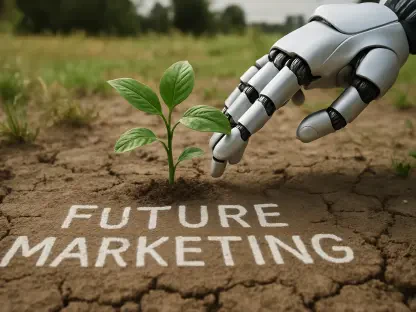

The near-universal adoption of artificial intelligence in marketing has created an unforeseen challenge where the very tools designed to give brands a competitive edge are now leveling the playing field. As organizations increasingly rely on algorithms to brainstorm topics, identify keywords, and structure calendars, the resulting strategies can lack the distinctiveness necessary to capture audience attention. This growing reliance on automation underscores a critical need for human oversight to infuse personality, strategic insight, and authentic connection back into the content planning process, ensuring that efficiency does not come at the cost of originality.
With 85 Percent of Marketers Using AI: Is Your Content Sounding Like Everyone Elses
The integration of AI into content creation and planning is no longer a fringe trend but an industry standard. Data from a recent CoSchedule survey reveals that 85% of marketers now leverage AI for various tasks, including the foundational work of building their content calendars. This widespread adoption signals a significant shift in workflow, prioritizing speed and data-driven suggestions to keep pace with digital demands.
However, this ubiquity presents a significant risk: a marketplace saturated with homogenous content. When the majority of competitors use tools trained on similar public data sets, their outputs—from topic suggestions to keyword clusters—inevitably converge. Without deliberate human intervention, a brand’s content plan can easily become a mirror image of its rivals, failing to establish a unique voice or provide differentiated value to its target audience. The result is a digital echo chamber where distinction is lost.
The AI Advantage and Its Pitfalls: Balancing Automation with Authenticity
The appeal of using AI for content planning is undeniable, rooted in its capacity for speed, synthesis, and comprehensive scope. These tools can generate a detailed content calendar in minutes, a task that once consumed hours of manual research. They excel at synthesizing information from countless data sources, identifying trending topics, and even comparing a proposed calendar against competitors to highlight potential content gaps. This allows teams to accelerate their planning cycles and ensure broad topic coverage with remarkable efficiency.
Despite these benefits, an over-reliance on AI carries hidden risks that can undermine a content strategy. The output can often sound robotic or generic, lacking the nuance and personality that define a strong brand voice. Furthermore, AI models possess knowledge gaps, as they cannot fully grasp a company’s unique products, specific audience personas, or internal business priorities. This is compounded by the persistent risk of inaccuracies and “hallucinations,” where the generated information is outdated or entirely fabricated, making careful human verification an indispensable final step.
Injecting the Human Element to Manually Refine Your AI Generated Plan
A critical refinement involves prioritizing audience resonance over sheer volume. An AI might suggest a high-traffic keyword, but a human strategist must assess whether the user intent behind that keyword truly aligns with their audience personas. For example, for a company specializing in vacation home insurance, an AI might propose targeting the broad term “renters’ insurance.” A human expert would recognize the need for a more specific keyword like “vacation home insurance” to attract a qualified, high-intent audience rather than irrelevant traffic.
Strategic alignment also requires syncing the content calendar with the brand’s internal pulse. AI tools are generally unaware of a company’s upcoming product launches, trade show participation, or significant milestones. Manually mapping these key events into the calendar ensures that content is created to support and amplify these business-critical moments. Similarly, incorporating value-aligned observances—such as a veteran-owned firm creating content around Veterans Day—adds a layer of authenticity that an algorithm cannot replicate.
Finally, the most potent human touch comes from infusing a unique brand voice and cultivating thought leadership. An AI-generated headline may be functional, but it often lacks personality. Rewriting titles to reflect the brand’s tone—be it witty, authoritative, or empathetic—makes the content more engaging from the very first impression. Beyond this, it is essential to schedule and prioritize original perspective pieces from internal experts. This brand-aligned thought leadership moves beyond keyword-driven articles to reinforce what the company stands for, reminding audiences of the human expertise and values behind the brand.
Lessons from the Field: Expert Examples and Data Backed Realities
For a masterclass in applying a distinctive brand voice, one can look to Ann Handley’s newsletter, “Total Annarchy.” Subject lines such as “Justice for Em Dashes!” and “New Data Just Dropped: Blogging in 2025” exemplify how to balance professional credibility with an engaging, human personality. This approach demonstrates that even at the planning stage, content titles can be crafted to be both informative and memorable, setting the tone for a piece that connects with readers on a personal level rather than just serving an algorithm.
The statistical imperative for this human-centric approach is reinforced by the same data highlighting AI’s prevalence. With the overwhelming majority of marketers using these tools, differentiation is no longer an option but a necessity for survival and growth. The insights from the CoSchedule survey do not merely point to a new tool in the marketer’s toolkit; they signal a fundamental shift in the competitive landscape. In this new reality, the brands that succeed will be those that use AI for efficiency but rely on human judgment for strategy, creativity, and genuine connection.
Your Actionable Blueprint: A Step by Step Guide to Humanizing Your Strategy
The first phase of humanizing an AI-generated plan is analytical. It begins with meticulously scrutinizing the suggested keywords to confirm they align with true audience intent, not just search volume. Concurrently, these proposed topics must be cross-referenced using SEO tools. This essential due diligence helps identify potential keyword cannibalization with existing content, confirms that topics are worth the investment based on search volume and difficulty, and uncovers strategic gaps that the AI may have missed.
The second phase shifts from analysis to strategic and creative integration. This involves manually mapping key company events, trade shows, and value-aligned observances onto the calendar to create timely and relevant content. Following this, AI-generated titles should be rewritten to capture the brand’s distinct personality and tone, transforming generic headlines into compelling hooks. Finally, the plan must make deliberate room for original thought leadership, scheduling perspective pieces from internal experts to showcase unique insights and build authority beyond algorithm-driven topics.
The journey toward a more effective content strategy did not involve abandoning powerful automation but rather augmenting it with irreplaceable human insight. By treating an AI-generated calendar as a first draft instead of a final directive, marketing teams transformed potential mediocrity into a powerful tool for building brand authority and fostering long-term growth. The most successful content plans were ultimately a testament to the symbiotic relationship between machine efficiency and human creativity, a partnership that yielded results neither could achieve alone.