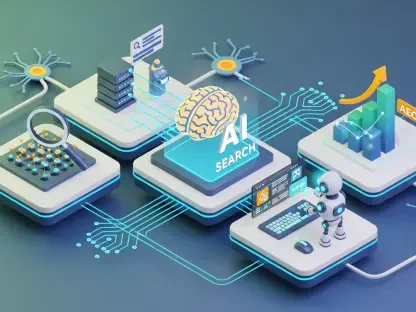

Imagine a world where marketing campaigns are not just planned but intuitively crafted, predicting consumer needs before they even arise, all within a single year of technological evolution. This isn’t a distant dream but a reality unfolding right now in 2025, as artificial intelligence (AI) reshapes the very foundation of marketing strategy. The speed at which AI has moved from a curious experiment to an indispensable ally is staggering, turning traditional approaches upside down. This report dives into the transformative journey of AI in marketing over the past twelve months, exploring how it has redefined efficiency, innovation, and consumer engagement in an industry racing to keep pace with relentless change.
AI’s Rising Role in the Marketing Landscape
The integration of AI into marketing has undergone a dramatic shift, transitioning from a shiny new tool to a cornerstone of strategic planning within a mere year. No longer just a buzzword, AI now influences every facet of the industry, from campaign design to customer interaction. Its rapid adoption reflects a broader realization among marketers that staying competitive demands more than just human intuition—it requires data-driven precision at scale. This shift has positioned AI not as an optional add-on but as a critical component driving decisions in real-time across global markets.
The scope of AI’s influence spans diverse marketing segments, touching everything from content creation to predictive analytics. Key technologies like generative AI and machine learning fuel this change, enabling brands to craft hyper-personalized experiences with unprecedented accuracy. Meanwhile, a dynamic clash between traditional vendors and AI-native platforms has emerged, each vying to define the future of marketing tech. Adding to this complexity are consumer-driven disruptions, where end-users increasingly rely on AI tools for decision-making, forcing marketers to adapt swiftly to maintain relevance in a rapidly evolving digital landscape.
Key Shifts in AI-Driven Marketing Strategies
From Efficiency to Strategic Growth
Just a year ago, AI in marketing was largely about streamlining tasks—think automated content ideation or quick copywriting tweaks for efficiency. Fast forward to today, and the narrative has shifted dramatically toward strategic growth. Marketers are now leveraging AI to unlock innovation, focusing on revenue generation rather than just cutting corners. This evolution signals a deeper understanding that AI’s true power lies in creating value, not merely saving time, pushing brands to rethink how they measure success in a competitive arena.
Consumer behavior has also played a pivotal role in this transformation. With a growing number of individuals turning to AI-powered search tools for research and purchasing decisions, marketers face new challenges in visibility. Strategies like AI Engine Optimization (AEO) and Generative Engine Optimization (GEO) have emerged as vital tactics, helping brands structure content to stand out in AI-driven results. This adaptation underscores a broader trend: marketing must now prioritize alignment with technology that consumers use daily, rather than solely focusing on internal processes.
Market Impact and Future Projections
Data from recent industry insights paints a clear picture of AI’s deepening footprint. Reports indicate that 85.4% of marketers currently use AI to enhance existing tools rather than replace them, reflecting a preference for integration over disruption. On the consumer side, about 50% rely on AI for research and buying choices, a statistic that highlights the urgency for brands to adapt. These numbers suggest a marketing landscape increasingly intertwined with AI at every touchpoint, reshaping how engagement is defined.
Looking ahead, projections point to AI’s role only growing more pronounced between 2025 and 2027. The focus will likely remain on quality data as the backbone of effective AI deployment, ensuring insights are both actionable and reliable. Strategic integration across customer journeys is expected to become standard, with brands weaving AI into every interaction to drive measurable outcomes. This trajectory hints at a future where marketing success hinges on mastering AI’s potential while navigating its complexities with finesse.
Challenges in Adopting AI for Marketing Excellence
Despite the promise of AI, adoption is not without hurdles. One persistent issue is the quality of data feeding these systems, with over half of marketers grappling with inconsistent or outdated inputs that skew AI outputs. This challenge undermines the very precision AI promises, leaving campaigns vulnerable to missteps. Addressing this requires a fundamental shift in how data is managed, moving beyond mere collection to rigorous validation and updates.
Additionally, the rapid pace of consumer-driven disruptions adds another layer of difficulty. As end-users increasingly shape digital interactions through AI tools, marketers struggle to maintain visibility in a search environment dominated by algorithms they don’t fully control. Solutions like Context Engineering, which focuses on integrating reliable data from various sources, are gaining traction as a way to improve AI accuracy. Moreover, innovative approaches to content structuring are being explored to ensure brands remain discoverable amidst these shifts, highlighting the need for agility in strategy.
Navigating the Regulatory and Ethical Terrain of AI in Marketing
As AI embeds deeper into marketing, the regulatory landscape looms large, demanding careful navigation. Data privacy laws are tightening globally, compelling brands to prioritize transparency in how AI handles consumer information. Ethical considerations also come into play, as the line between personalization and intrusion blurs, raising questions about trust. Marketers must balance the drive for innovation with the imperative to respect boundaries, ensuring AI applications don’t overstep.
Compliance and security measures are no longer optional but essential for building consumer confidence. The impact of these regulations is evident in slower technology adoption for some, as brands weigh the risks of non-compliance against the benefits of AI. Yet, those who embrace transparent practices stand to gain a competitive edge, proving that ethical marketing can coexist with cutting-edge tech. This delicate dance between regulation and innovation will likely shape AI’s trajectory in the industry for years to come.
The Future of AI in Shaping Marketing Horizons
Peering into the horizon, emerging trends suggest AI will further redefine marketing’s strategic core. Marketing Operations (MOps) teams, for instance, are evolving into “business value engineers,” tasked with translating AI capabilities into tangible growth. This shift underscores a broader move toward marketing as a driver of organizational change, where technical expertise meets business acumen to create impact. The potential for AI to personalize customer experiences at an even granular level also promises to elevate engagement to new heights.
However, potential disruptors loom, from evolving consumer AI tools that could upend current strategies to global economic factors influencing tech investment. Staying competitive will demand continuous innovation, with brands needing to anticipate shifts before they occur. The interplay of these forces suggests a future where adaptability is paramount, and marketers must remain nimble to harness AI’s full potential while sidestepping unforeseen pitfalls in a dynamic field.
Reflecting on AI’s Marketing Revolution and Path Forward
Looking back over the past year, AI’s impact on marketing strategy stood out as nothing short of revolutionary, morphing from a tool of efficiency to a catalyst for growth and consumer-centric innovation. Each advancement, from data-driven personalization to strategic integration, painted a picture of an industry reborn through technology. The challenges encountered along the way only sharpened the focus on what truly mattered: leveraging AI to connect meaningfully with audiences.
Moving forward, actionable steps emerged as critical for sustained success. Prioritizing data quality became a non-negotiable foundation, ensuring AI’s insights remained trustworthy. Embracing hybrid models that blend traditional marketing tech with AI offered a balanced path to innovation. Finally, positioning marketing teams as leaders in organizational change through strategic AI adoption promised to redefine industry standards, paving the way for a future where technology and human insight worked hand in hand to shape unparalleled customer experiences.