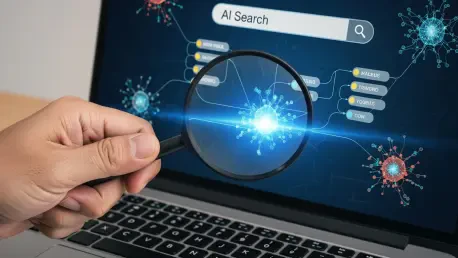

A perplexing pattern is emerging in marketing analytics dashboards across industries: a steady, often significant, rise in direct traffic that defies conventional explanation. While teams investigate potential tracking errors or misattributed campaigns, the true cause often lies hidden in plain sight—a fundamental shift in consumer behavior driven by artificial intelligence. AI-powered search is rewriting the rules of discovery, rendering traditional attribution models increasingly obsolete by favoring brand recall over immediate clicks. This analysis will dissect this growing phenomenon, offer a framework for tracking its impact with existing tools, and explore the future of marketing attribution in an AI-first digital landscape.
The New Customer Journey: From AI Answer to Direct Action
The “Read, Remember, Return” Behavior Model
The core of this trend lies in recognizing that AI-generated mentions function more like brand advertising than traditional search links. When an AI response includes a brand, it places that name on a user’s mental shortlist at a critical moment of problem-solving. This interaction fosters brand recall rather than prompting an immediate click, creating a delayed but more valuable user action later on.
This is because the conversational and summarized format of AI answers naturally boosts memory retention. Instead of scanning a list of blue links and making a choice, the user receives a single, curated response that feels like a recommendation. The information is pre-processed and packaged as a decision-ready explanation, bypassing the typical friction of comparison and research. Consequently, the user internalizes the brand name more effectively.
This dynamic creates a distinct user journey. A person reads an AI-generated answer, remembers a brand mentioned within it, and later returns directly to that brand’s website when they are ready to act. This return visit—whether it happens hours, days, or even weeks later—is driven by intent, not by a click-through from a search engine. The user has moved from exploration to decision, and their first action is to seek out the brand they now recall.
Manifestations in Marketing Analytics
This recall-driven behavior is precisely why these valuable visits often surface as “Direct” or “Unassigned” traffic in analytics platforms like Google Analytics 4 (GA4). In modern analytics, the “Direct” channel is effectively a catch-all category for sessions where GA4 cannot reliably identify the referral source. This attribution gap is becoming more common as user journeys fragment across different platforms and devices.
The technical reasons for this lost referrer data are numerous and growing. Cross-device journeys, where a user researches on mobile and later converts on a desktop, frequently break the attribution chain. Similarly, in-app browsing, a common way users interact with AI tools, often strips referral information before a user lands on a website. Combined with enhanced browser privacy features and the simple act of a user typing a URL from memory, the result is a significant portion of traffic with an obscured origin.
A concrete scenario illustrates this perfectly: a user researches “best project management tools for small teams” on an AI platform on their smartphone during their commute. They see a particular brand mentioned favorably in the summary. Later that day, at their desktop computer, they open a new browser tab and type that brand’s name or URL directly into the address bar. In their analytics, this appears as a brand new, high-intent direct session with no discernible marketing source.
Expert Guidance: Validating the Impact of AI Mentions
The emerging expert consensus is clear: pursuing perfect, one-to-one attribution for AI-driven mentions is currently impossible and a counterproductive goal. The nature of this user journey, defined by a gap between information consumption and action, does not leave a clean digital trail for last-click models to follow. Attempting to force it into old frameworks leads to inaccurate conclusions and missed opportunities.
Therefore, the strategic imperative is shifting from seeking perfect attribution to building a strong directional case based on a convergence of signals. Marketers must learn to connect the dots between increased visibility in AI environments and subsequent lifts in high-intent traffic, even when a direct causal link is not visible in standard reports. This requires a more holistic and inferential approach to performance analysis.
This new mindset reinforces a crucial insight: marketers must learn to see the outcome—a rise in high-quality traffic and conversions—even when they cannot see the initial click. The value of AI visibility is not measured in click-through rates but in its ability to generate brand demand. Success is validated by observing corresponding growth in direct visits, branded searches, and stronger engagement metrics.
The Future of Attribution: A Practical Framework
A New Measurement and Validation Strategy
A practical approach to validate the relationship between AI visibility and traffic growth involves correlating data from multiple sources to build a compelling narrative. Instead of searching for a single source of truth, marketers can triangulate data points to confirm that AI mentions are influencing user behavior in a measurable way.
This strategy begins in Google Search Console, which reveals demand signals that exist before a click occurs. A rise in impressions for branded and navigational queries (e.g., “brand vs. competitor,” “brand pricing,” “brand login”) is often the first indicator that brand recall is increasing. These searches demonstrate that more people are actively looking for a specific brand, a direct result of being remembered.
This data should then be correlated with trends in GA4. Marketers should look for corresponding lifts in direct and branded organic sessions during the same period. More importantly, the quality of this traffic should be scrutinized. An increase in high-intent metrics like engagement rate, conversion rate, and the share of returning users from these channels provides strong evidence that AI-influenced visitors are arriving further down the decision-making funnel.
Broader Implications for Marketers
The primary challenge this trend presents is that AI summarization can reduce clicks to top-of-funnel content while simultaneously increasing brand recall and high-value direct traffic. This means that traditional content marketing KPIs, like page views and organic sessions to blog posts, may decline, even as the content’s influence on revenue grows.
However, this challenge comes with a significant benefit: a necessary shift in focus from traffic volume to traffic value. Visitors influenced by AI-generated recommendations often arrive with higher intent and are more prepared to convert. They have already been “pre-sold” on a solution, making their subsequent engagement more efficient and valuable for the business.
In the long term, this evolution will reshape marketing roles. Understanding these complex, multi-touch, and often un-trackable customer journeys will become a critical skill. Success will depend less on optimizing for the last click and more on building a brand that is memorable enough to be the answer when a user is ready to act.
Conclusion: Embracing Recall as a Key Performance Indicator
The rise of AI-powered search has introduced a new dynamic into the marketing ecosystem, where visibility generates brand recall that later manifested as high-quality direct and branded traffic. This trend confirmed that traditional attribution models, heavily reliant on tracking the last click, were becoming insufficient for capturing the full value of a brand’s digital presence.
It became imperative for marketing teams to adapt their measurement strategies. The most successful organizations moved beyond last-click attribution and learned to track recall-led signals across platforms like Google Search Console and GA4. By correlating branded search demand with high-intent direct traffic, they built a more accurate picture of marketing’s impact.
Ultimately, this shift solidified the view that AI visibility is a powerful brand-building channel, not just a traffic source. The brands that thrived were those that measured success not by clicks, but by the ultimate impact on brand demand, customer intent, and tangible business outcomes.