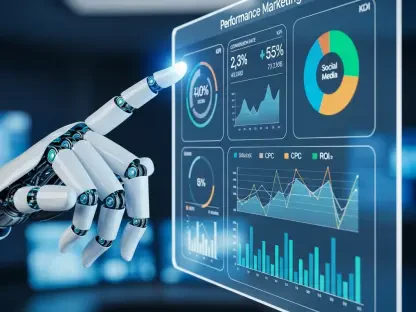

The familiar monologue of brands broadcasting messages to a passive audience has been decisively replaced by a dynamic, data-driven dialogue orchestrated by artificial intelligence. This technology represents a significant advancement in the marketing sector, acting as a catalyst for a new paradigm in business strategy and consumer interaction. This review will explore the evolution of AI in marketing, its key features, performance capabilities, and the impact it has had on reshaping the consumer-brand relationship. The purpose of this review is to provide a thorough understanding of the technology, its current applications, and its potential future development in the marketing landscape.
An Introduction to AI as a Marketing Catalyst
Artificial intelligence serves as the foundational engine for modern marketing, leveraging its capacity to process and analyze vast datasets to enact a strategic shift away from generalized outreach. The core principle involves moving beyond demographic-based segmentation toward a more nuanced understanding of individual consumer behavior, preferences, and intent. This transition allows for the creation of marketing initiatives that are not only targeted but also predictive and adaptive, anticipating consumer needs before they are consciously expressed.
Consequently, this technological integration is fundamentally redefining both business operations and consumer expectations. As individuals become accustomed to curated content feeds, personalized recommendations, and instantaneous support, they increasingly expect this level of tailored interaction from all brands. This sets a new competitive baseline, compelling businesses to adopt AI-driven strategies not merely for an advantage, but as a requisite for maintaining relevance and fostering customer loyalty in a crowded digital marketplace.
Key Features and Technological Components
Hyper Personalization and Predictive Analytics
At the heart of AI’s marketing prowess is its ability to facilitate hyper-personalization on an unprecedented scale. By analyzing extensive consumer data—from browsing history and social media engagement to past purchase patterns—AI algorithms can construct detailed profiles of individual users. This enables marketers to move beyond broad categories and craft unique, one-to-one interactions. The result is a more resonant brand message that speaks directly to the individual’s needs and interests, fostering a deeper connection and significantly improving conversion rates.
Complementing personalization is the function of predictive analytics, where machine learning models forecast future trends and consumer behaviors with remarkable accuracy. This capability provides businesses with a strategic foresight that informs critical decisions. For example, by anticipating demand for certain products, companies can optimize inventory management to prevent stockouts or overages. Similarly, predicting customer churn allows for proactive retention efforts, enabling brands to allocate resources more efficiently and secure long-term revenue streams.
Revolutionizing Customer Engagement and Experience
AI has profoundly reshaped the touchpoints where consumers and brands interact, particularly in the realm of digital advertising and customer support. AI algorithms now curate social media feeds and ad placements to ensure the content shown is highly relevant to a user’s inferred interests, transforming ads from interruptions into valuable suggestions. Simultaneously, the deployment of AI-powered chatbots and virtual assistants provides 24/7, instantaneous customer support, satisfying the modern consumer’s demand for immediate and effective problem resolution.
Furthermore, the convergence of AI with immersive technologies like augmented reality (AR) and virtual reality (VR) is unlocking new frontiers for brand experiences. These integrations allow consumers to interact with products in a virtual space before making a purchase. Virtual try-on solutions for fashion and interactive 3D models for home goods are prime examples, as they reduce purchase uncertainty and create memorable, engaging interactions. Such experiences not only enhance the decision-making process but also build a stronger emotional connection to the brand.
Streamlining Operations and Unifying the Customer Journey
Beyond its customer-facing applications, artificial intelligence is a powerful tool for streamlining internal marketing operations and boosting efficiency. A significant development is the use of AI for automated content creation, with algorithms capable of generating high-quality marketing copy, designing basic graphics, and even editing short promotional videos. This automation allows marketing teams to scale their content output significantly, ensuring a consistent brand voice across numerous platforms while freeing human talent to focus on high-level strategy and creative ideation.
Moreover, AI is crucial in realizing the goal of a truly omnichannel marketing strategy. Today’s consumers engage with brands across a fragmented landscape of touchpoints, including websites, mobile apps, social media, and physical stores. AI systems integrate data from all these channels to create a single, unified view of each customer’s journey. This holistic understanding enables businesses to deliver a seamless and consistent experience, where interactions in one channel inform and enhance experiences in another, fostering a cohesive and personalized brand relationship.
Emerging Trends and Innovations in AI Marketing
The trajectory of AI in marketing is shaped by continuous innovation, with generative AI emerging as a particularly transformative force. The sophistication of these models now extends far beyond simple text generation to include the scalable production of nuanced, context-aware content across various media. This allows brands to maintain a dynamic and highly relevant presence with less manual effort, personalizing campaigns at a granular level and responding to market trends in near real-time.
Another key trend is the deepening integration of AI with immersive technologies. The synergy between AI and AR/VR is creating novel brand interactions that are not merely functional but emotionally resonant. By personalizing virtual environments or augmenting a user’s reality with tailored information and experiences, brands can craft memorable moments that influence perception and buying behavior. These immersive encounters are becoming a new frontier for brand storytelling and consumer engagement.
Real World Applications and Industry Impact
The practical deployment of AI marketing is evident across numerous sectors, demonstrating its versatility and impact. In e-commerce, platforms use AI to power sophisticated recommendation engines that present users with products they are highly likely to purchase, significantly boosting sales. The travel industry leverages AI for dynamic pricing, adjusting flight and hotel costs in real-time based on demand, competition, and user behavior. Meanwhile, the hospitality sector employs sentiment analysis to parse thousands of customer reviews, gathering actionable insights to improve service and manage brand reputation.
Specific use cases further highlight AI’s operational value. AI-driven campaign management platforms, for example, have become indispensable for optimizing advertising spend. These systems continuously analyze the performance of various ad creatives and channels, automatically reallocating budgets toward the highest-performing assets. This not only maximizes the return on investment but also provides marketing teams with the agility to adapt their strategies based on live data rather than historical assumptions.
Challenges and Ethical Considerations
Despite its vast potential, the implementation of AI in marketing is accompanied by significant hurdles and ethical dilemmas. On a technical level, challenges persist around data quality, integration complexity, and the high cost of talent and infrastructure. However, the more pressing concerns are ethical, centering on consumer data privacy. As brands collect ever-increasing amounts of personal information, the imperative to use that data responsibly and transparently has become paramount for building and maintaining consumer trust.
Furthermore, the risk of algorithmic bias presents a substantial challenge. If the data used to train AI models reflects existing societal biases, marketing campaigns can inadvertently perpetuate stereotypes or unfairly exclude certain demographic groups. Addressing this requires a concerted effort to ensure data diversity and develop ethical frameworks that govern the design and deployment of AI systems. The long-term viability of AI in marketing will depend on the industry’s ability to navigate these limitations and prove its commitment to fairness and accountability.
The Future Trajectory of AI in Marketing
Looking ahead, the evolution of AI in marketing points toward even greater sophistication and integration into the core of consumer-brand dynamics. Potential breakthroughs in natural language understanding are poised to create hyper-realistic virtual assistants capable of nuanced, empathetic conversations, moving them from simple support tools to trusted brand ambassadors. This advancement promises a future where automated interactions feel genuinely personal and human-like.
The long-term impact of a fully integrated AI ecosystem will likely reshape the global economy and the very nature of consumerism. As AI becomes more adept at predicting needs and automating purchases, the consumer journey could become increasingly seamless and passive. This leads to a future that is not only more personalized and efficient but also profoundly more adaptive, where brands and consumers exist in a continuously optimized, intelligent, and interconnected relationship.
Conclusion and Overall Assessment
This review confirms that artificial intelligence is no longer an emerging technology in marketing but a foundational element of contemporary strategy. Its impact is most profound in driving unprecedented levels of personalization, revolutionizing customer engagement through automation and immersive experiences, and creating significant operational efficiencies. AI’s ability to analyze complex datasets provides a strategic advantage that is now central to competitive performance in the digital age.
Ultimately, the successful integration of AI into marketing depends on a dual commitment. While technological innovation remains crucial for staying ahead, it must be balanced with an unwavering dedication to ethical practices and the cultivation of genuine consumer trust. The brands that will define the future are those that harness the power of AI not just to optimize transactions, but to build meaningful, transparent, and valuable relationships with their customers.