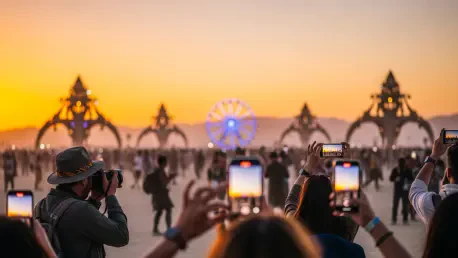

While millions of smartphones illuminate the Indio desert every April to broadcast a curated lifestyle to the world, the global football stage remains a digital fortress where every pixel is guarded by a phalanx of legal enforcers. This visual dichotomy represents more than just a difference in musical and athletic tastes; it illustrates a profound split in how the modern corporate world views the ownership of a moment. In 2026, the battle for digital supremacy is no longer about who has the most viewers, but who controls the narrative of those views.
The global landscape of major events has transformed into a high-stakes arena where the difference between being a viral sensation and a digital ghost depends entirely on an organization’s legal philosophy. While one entity treats its content as a vault that must be guarded at all costs, the other views its brand as a virus intended to spread through every possible social artery. This fundamental divide reveals a shifting landscape in how global giants define the value of their product in a creator-driven economy that values participation over observation.
This discrepancy is not a matter of legal capability but of fundamental business objectives and the intended audience for their respective content. To understand why one event thrives on shadows and silence while the other demands light and noise, one must look beneath the surface of the spectacle. The choice between protection and promotion dictates every legal filing, every takedown notice, and every sponsorship deal signed in the luxury boxes of the world’s most famous venues.
The Paradox of Twenty Billion Views and Digital Silence
How can the world’s most-watched sporting event, attracting over 20 billion video views, remain a ghost on social media while a music festival in the California desert dominates every digital feed? The contrast between the FIFA World Cup and Coachella is not an accident of timing or audience demographic, but a calculated choice in how intellectual property is wielded. FIFA maintains a strict lockdown on its digital presence, ensuring that the only way to experience the tournament is through official, high-priced channels.
In contrast, Coachella thrives on a creator-friendly ecosystem that turns every attendee into a volunteer marketing agent. By allowing influencers and average fans to flood platforms with content, the festival generates a sense of FOMO that sustains ticket demand and cultural relevance year after year. This creates a situation where the smaller event often feels much larger in the digital consciousness because its boundaries are intentionally porous.
The result is a strange reality where the most popular sport on earth feels inaccessible to the average content creator, while a three-day music festival feels like the center of the universe. This choice to remain silent on social platforms is a strategic move to preserve the scarcity of the product. By limiting the supply of unofficial content, the organizers ensure that the demand for the official broadcast remains at a fever pitch, regardless of the cultural conversation happening elsewhere.
The Legal Framework Governing Modern Global Events
To understand the friction between content creators and event organizers, one must look at the three pillars of control that dictate what can be filmed and shared. Trademark law protects the commercial identity of phrases like “World Cup” or “Coachella,” ensuring that non-sponsors cannot profit from the prestige of the brand. These marks are the first line of defense, preventing unauthorized companies from piggybacking on the event’s global recognition to sell unrelated products.
Copyright law provides the ultimate gatekeeping power, giving organizers ownership over every broadcast angle and performance recording produced within the venue. Because match footage is considered an original work of authorship, any unauthorized clip posted to social media is a direct violation that can be met with an immediate takedown. Finally, contractual exclusivity binds these organizations to their sponsors, often legally requiring them to suppress any unofficial content that might dilute the value of a multimillion-dollar partnership.
These legal tools are identical for both entities, yet they are applied with vastly different levels of aggression. For one, the law is a sword used to clear the field of competitors; for the other, it is a shield used only when the brand’s core identity is threatened. Understanding this legal architecture is essential for any brand or creator hoping to survive in an environment where a single copyright strike can end a digital career.
Distinct Business Models: Protected Assets versus Promotional Catalysts
FIFA and Coachella operate on diametrically opposed economic engines that dictate their legal aggression toward content creators. For FIFA, the broadcast is the primary commodity; the organization generates the bulk of its revenue by selling exclusive media rights to broadcasters and global partners like Adidas. Allowing fans or creators to distribute high-quality match clips would directly undermine the exclusivity these partners pay hundreds of millions to secure. If the goals are available for free on a social feed, the value of the live broadcast drops.
In contrast, Coachella sells an aspirational lifestyle and an in-person experience, treating social media as a free marketing machine. The festival’s business model depends on the idea that the event is the place to be, and there is no better way to prove that than by having thousands of people post about it simultaneously. By allowing influencers and attendees to broadcast the “vibe” of the desert, the organizers turn their intellectual property into a promotional catalyst that drives future ticket sales and sponsorship interest.
The divergence highlights a major trend in the digital economy: the shift from viewing content as a protected asset to viewing it as distributed social capital. FIFA treats its content as a closed-loop commodity, ensuring that every cent of value is extracted through official channels. Coachella, meanwhile, understands that organic reach is a currency of its own, one that can be used to build a brand image that transcends the music itself and lives in the cultural zeitgeist.
Measuring the Economic Power of Exposure and Exclusivity
The effectiveness of these strategies is reflected in staggering market data and industry outcomes that justify each organization’s approach. Research into brand activations during Coachella suggests that the festival’s first weekend alone can generate nearly $870 million in Media Impact Value. This figure is made possible only through an ecosystem that encourages brands to build “houses” and influencers to film every waking moment, creating a wave of publicity that no traditional ad campaign could replicate.
On the other hand, FIFA’s rigid enforcement ensures that its official sponsors remain the only voices legally permitted to associate with the tournament’s prestige. This exclusivity allows FIFA to command astronomical fees for its commercial rights, as partners know they will not have to compete with “ambush marketing” from rivals. Expert analysis suggests that both models are highly successful, proving that legal enforcement is a function of a brand’s specific revenue goals rather than a universal requirement for success.
The choice between these two models often comes down to the nature of the product being sold. A sporting event is a linear narrative with a clear beginning and end, making the live footage the most valuable part of the equation. A music festival is an atmospheric event where the specific performances are often secondary to the social experience. Consequently, the economic power of exclusivity works for the athlete, while the economic power of exposure works for the influencer.
A Strategic Framework for Navigating Brand Enforcement Styles
For brands and creators looking to capitalize on global events, success requires identifying whether an organizer views content as a protected asset or a promotional fuel. When navigating a “Closed-Loop” environment like FIFA, the focus must remain on original commentary or lifestyle content that avoids using protected trademarks or broadcast footage to escape rapid takedowns. In these spaces, creators who try to act like broadcasters often find themselves silenced by automated legal scripts before their content can even gain traction.
Conversely, in a “Distributed Capital” environment like Coachella, the goal is to lean into the organic reach of the event, leveraging the high visibility of the festival to build a brand identity. Creators in these spaces should focus on high-quality production that complements the event’s aesthetic, as the organizers are likely to leave them alone as long as they are contributing to the overall buzz. Recognizing these underlying business objectives allows creators to produce content that either aligns with the organizer’s marketing engine or sidesteps their legal triggers.
The successful implementation of these polar strategies demonstrated that brand protection was never a one-size-fits-all legal requirement. Organizations that prioritized the long-term vitality of their digital ecosystems moved toward a more nuanced understanding of content ownership. This historical shift provided a template for future events to balance the necessity of exclusive rights with the undeniable power of decentralized, creator-driven marketing. Future leaders in the industry examined these precedents to determine how digital openness could be monetized without sacrificing the integrity of high-value broadcast rights.