
Milena Traikovich has built a career on the cutting edge of demand generation, helping brands navigate the increasingly complex intersection of physical presence and digital performance. As an expert in analytics and lead optimization, she understands that modern consumers don’t live in a vacuum; their online actions are often sparked by the world around them. In this discussion, we explore the powerful synergy between digital marketing and Out-of-Home (OOH) advertising, a relationship she refers to as the “two-screen effect.” We delve into how public displays in high-traffic hubs like airports and rail stations serve as the ultimate primer for private-screen engagement, the technical evolution of programmatic targeting, and why OOH is becoming the secret weapon for supercharging digital spend.
How does the “two-screen effect” specifically enhance the performance of online and social media campaigns, and what metrics should digital marketers track to measure the direct influence of physical screens on branded search and conversion rates?
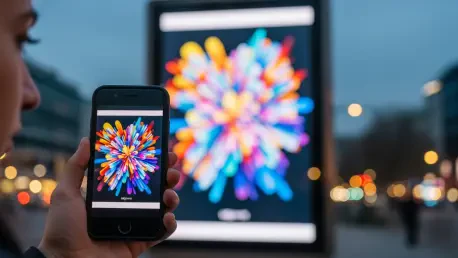
The “two-screen effect” is a fascinating psychological phenomenon where the public screen of Out-of-Home advertising acts as a primary catalyst for the private screen of a smartphone. When a consumer encounters a bold, high-impact display in a city center or a transit hub, it builds a sense of brand fame and trust that a small mobile banner simply cannot replicate. This physical encounter primes the brain, making the user much more likely to engage with a social media ad or a search result later that day. To truly measure this influence, marketers need to look closely at spikes in branded search volume and social engagement rates immediately following a campaign launch in specific geographic areas. By tracking the lift in online conversions within those physical catchment zones, you can see the undeniable proof that the real world is driving digital behavior.
When integrating programmatic Out-of-Home technology into an omnichannel strategy, what are the technical steps for personalizing content at scale, and how do these capabilities improve targeting compared to traditional static displays?
The shift toward programmatic Out-of-Home has completely changed the game by allowing us to treat physical screens with the same agility as digital display ads. Technically, this involves using data-driven triggers—such as weather changes, flight times at an airport, or local foot traffic patterns—to serve specific creative content in real-time. Unlike traditional static displays that remain fixed for weeks, programmatic technology allows for hyper-relevant targeting at scale, ensuring the message resonates with the specific audience passing by at that exact moment. This capability ensures that a brand stays relevant and flexible, placing digital Out-of-Home at the very heart of a modern omnichannel campaign. It removes the guesswork and allows marketers to align their physical presence with the fluid nature of their online strategies.
Given the findings from the “Point of Search” and “Point of Social” studies, how does public advertising prime consumers for private-screen engagement, and what specific design elements ensure a seamless transition from a physical encounter to an online action?
Our research into the “Point of Search” and the latest insights from “The Point of Social” show that public advertising creates a powerful mental anchor for the consumer. When someone sees a vibrant, large-scale ad in a shopping mall, it establishes a level of credibility that makes the brand feel “famous” and ubiquitous. To make the transition to the private screen seamless, designers should focus on high-contrast visuals and clear, concise messaging that can be processed in seconds. Incorporating recognizable brand assets and strong calls to action ensures that when the user later sees a related post on their social feed, the recognition is instantaneous. This continuity is what transforms a fleeting glance in a rail station into a deliberate click on a mobile device.
Many brands struggle with measuring the effectiveness of real-world placements within a digital-heavy budget; what framework do you recommend for assessing cross-channel attribution, and how does this data justify the “multiplier effect” on overall marketing spend?
I always recommend a framework that prioritizes holistic measurement over siloed digital metrics, specifically looking for the “multiplier effect” where OOH makes every other dollar work harder. By comparing regions with OOH coverage against those without, brands can observe a clear discrepancy in the cost-per-acquisition on their digital channels. The data consistently shows that when OOH is present, the effectiveness of social and search spend increases because the audience has already been warmed up by the public screen. This justification is crucial for digital-heavy budgets; it demonstrates that OOH isn’t just an extra expense, but a strategic investment that lowers the overall friction of the customer journey. Seeing those conversion numbers climb while your digital spend remains constant is the ultimate proof of value.
What are the logistical challenges of aligning digital screen placements in high-traffic areas like airports and malls with real-time social media trends, and what specific workflows allow an agency to maintain brand consistency across these different environments?
The primary challenge lies in the sheer speed of digital culture and ensuring that a high-profile physical placement doesn’t feel outdated by the time it goes live. To overcome this, agencies must adopt automated workflows that allow creative assets to be updated across thousands of digital screens simultaneously through a central management system. Maintaining brand consistency requires a “digital-first” mindset where the visual language used in a 15-second social clip is expertly adapted for the grand scale of a city billboard. We work closely with brands to ensure that the emotional tone and aesthetic remain identical, whether the consumer is looking at a screen in a quiet rail carriage or a bustling airport terminal. This synchronization is what builds a truly cohesive brand narrative that lives both in the pocket and in the world.
What is your forecast for the future of programmatic Out-of-Home and its role in the digital marketing ecosystem?
I believe we are moving toward a future where the distinction between “online” and “offline” marketing will completely evaporate as programmatic Out-of-Home becomes fully integrated into the standard digital buying stack. We will see even more sophisticated uses of real-time data to trigger hyper-local content, making the public screen as personal and responsive as a social media feed. As measurement tools become more refined, OOH will no longer be seen as a secondary awareness tool but as a primary driver of performance and lead generation. Ultimately, the brands that thrive will be those that master the art of the “two-screen effect,” using the physical world to build the fame and trust necessary to win on the digital screen.