
Milena Traikovich helps businesses drive effective campaigns for nurturing high-quality leads. As our Demand Gen expert, she brings extensive experience in analytics, performance optimization, and lead generation initiatives. Today, she’s here to unravel a perplexing trend in B2B marketing: why American marketers, despite having the largest budgets, are also the most anxious about hitting their goals. We’ll explore the pressures driving this paradox, the strategic pivot to brand and content, and the growing disconnect between marketing teams and the C-suite on the real-world impact of AI.
Many US B2B marketers recently saw budget increases, yet report low confidence in meeting growth targets. What pressures create this paradox, and how can leaders recalibrate spending for better efficiency and morale? Please share some key metrics they should be tracking.
It’s a fascinating and frankly, stressful situation for many marketing leaders. You’re handed more money, which should feel like a vote of confidence, but the pressure cooker is just turned up higher. The data shows that 55% of U.S. marketers saw their budgets grow, yet they have the lowest confidence of any region. I believe this stems from a period of aggressive investment where spending may have outpaced actual market demand. Now, there’s this nagging feeling, this whisper in the boardroom, asking if the current spend is even sustainable. To recalibrate, leaders need to shift their focus from pure volume to efficiency. Instead of just tracking lead counts, they must rigorously measure cost per qualified lead and, more importantly, the lead-to-customer conversion rate. This forces a much-needed conversation about quality over quantity and helps prove that the marketing engine isn’t just burning cash, but building real, sustainable value.
With brand and content now accounting for nearly 16% of marketing spend, what strategic goals does this serve beyond capturing AI-driven search traffic? Please outline a step-by-step process for measuring the ROI on these long-term initiatives, perhaps with an anecdote.
That 15.8% figure is a huge signal. It tells us marketers are moving beyond short-term lead gen tactics and are playing the long game. Yes, capturing traffic from new AI search models is a major driver, but it’s fundamentally about building a moat around your business. In a world of automated content and fleeting attention, a strong brand is one of the few defensible assets you have. It builds trust and preference that can’t be easily replicated. Measuring this isn’t simple, but it’s doable. First, you benchmark brand-related organic search volume and share of voice. Second, you consistently create and distribute high-value content, tracking engagement metrics not just as vanity numbers, but as indicators of audience resonance. Third, after six to twelve months, you analyze the trend lines. Are more people searching for your brand by name? Are you seeing an uplift in direct traffic and conversions from your content hubs? I worked with a team that did exactly this. For months, it felt like shouting into the void, but then we saw organic search for their brand name triple, and their sales team started reporting that new leads were coming in pre-educated and ready to buy. That’s the ROI of brand and content.
In the U.S., about 27% of marketing leaders believe the C-suite overestimates AI’s financial impact. What causes this expectation gap, and what practical steps can marketers take to communicate AI’s realistic capabilities and timelines to senior leadership? An example would be helpful.
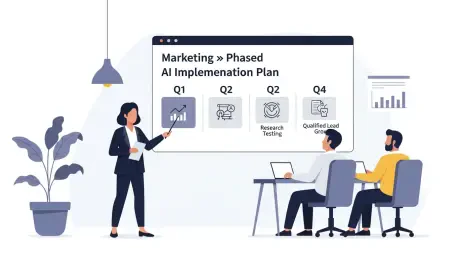
This expectation gap is a classic case of the hype cycle clashing with the reality of implementation. The C-suite hears about AI revolutionizing everything overnight, so they expect immediate, massive financial returns. But marketers are the ones on the ground, grappling with the tools, the data integration, and the workflow changes. That 27% of U.S. leaders feeling this pressure isn’t surprising at all, especially since U.S. companies are leading the charge in AI investment. The best way to manage this is to shift the conversation from “magic” to “method.” For instance, instead of just saying “we’re investing in an AI research tool,” frame it as a phased project. You could tell your CEO, “In Q1, our goal is to use this AI tool to reduce market research time by 40%. In Q2, we will leverage that speed to test three new product messaging angles. By Q4, we project this will contribute to a 5% lift in qualified leads from our product marketing efforts.” This approach grounds the investment in tangible, incremental outcomes and replaces hype with a clear, defensible roadmap.
What is your forecast for B2B marketing?
My forecast is a move toward what I call “ruthless efficiency.” The era of growth-at-all-costs, fueled by massive, sometimes untracked, budgets is ending. We will see a recalibration where every dollar is scrutinized for its return, not just on leads, but on genuine pipeline and revenue. AI won’t be a shiny object anymore but a fundamental part of the operational toolkit, used for scaling everything from research to content. At the same time, the strategic investment in brand and content will only accelerate. Marketers now understand that in an increasingly automated world, a trusted brand and a library of expert content are the most durable competitive advantages. The winners will be the teams that master this dual approach: leveraging technology for maximum efficiency while investing patiently in the human elements of trust and authority.