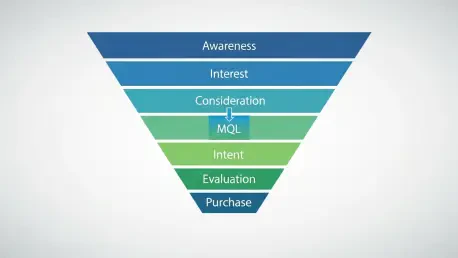

The Marketing Qualified Lead (MQL) is a relic of a simpler era. For years, B2B marketing teams have chased MQL quotas, celebrating volume as a proxy for success. Yet, the data tells a different story. Industry benchmarks show that on average, only around 13% of MQLs convert into Sales Qualified Leads, meaning most marketing-generated leads don’t ultimately reach the sales-ready stage. This isn’t just inefficient. It’s a fundamental breakdown in the revenue engine.
This gap between marketing activity and sales outcomes creates friction, wastes budget, and erodes trust. Sales teams dismiss marketing leads as low-quality noise, while marketing leaders point to meeting quotas. The problem lies in the metric itself. The MQL was built for a linear world, but modern B2B buying is a complex, multi-threaded process involving an average of four or more stakeholders in any given deal. Focusing on a single “lead” is like trying to understand an ocean by measuring a single puddle.
It is time for a new playbook. Success in today’s market requires shifting focus from lead volume to pipeline velocity, from individual actions to account-level intent, and from marketing-centric milestones to shared revenue goals. This article outlines the key demand generation metrics that drive real business impact, align sales and marketing, and build a predictable engine for growth.
The Problem with the MQL-Centric Factory
For too long, demand generation has been treated as an assembly line for leads. Marketing’s job was to produce a certain number of MQLs, which were then passed to sales. This model is broken. An obsession with MQL volume incentivizes quantity over quality, rewarding marketing for activities that do not translate into revenue.
This misalignment creates several critical business challenges:
Wasted Sales Cycles: When sales reps are forced to chase unqualified leads, they burn valuable time that could be spent on high-intent accounts. This extends sales cycles, tanks morale, and hurts win rates.
Eroded Trust: The constant handoff of low-quality leads creates a classic silo effect. Sales loses faith in marketing’s ability to deliver value, leading reps to ignore inbound leads altogether and rely solely on their own prospecting efforts.
A False Finish Line: Declaring victory at the MQL stage is a critical error. A whitepaper download or webinar registration is a starting point, not a conclusion. Real demand generation nurtures the entire buying committee through a long and nonlinear journey.
Ignoring the Buying Committee: B2B decisions are made by groups, not individuals. An MQL represents one person’s interest, but it fails to capture the engagement of the other stakeholders crucial to the deal. This is why many organizations are moving toward Marketing Qualified Accounts, which measure engagement across an entire target company.
The New Scorecard: From Volume to Value
To fix the model, marketing leaders must adopt a new set of KPIs that reflect genuine buying intent and align directly with sales outcomes. These metrics move beyond vanity and measure what truly matters: a qualified pipeline.
Sales Qualified Leads and Sales Accepted Leads
The first and most important shift is to measure marketing’s success based on the leads that sales actually accept and agree to work with. An SQL is a lead that has been vetted and deemed ready for a direct sales conversation, often after an initial discovery call. Tracking the MQL-to-SQL conversion rate is the ultimate diagnostic for lead quality. If this rate is low, it’s a clear signal that lead scoring criteria, targeting, or messaging needs immediate improvement. A high SQL rate indicates strong marketing and sales alignment.
Marketing Qualified Accounts
In an account-based marketing world, the MQA is rapidly replacing the MQL. Instead of tracking a single lead, an MQA tracks the collective engagement of multiple stakeholders within a target account. An account becomes “marketing qualified” when it hits a predetermined threshold of engagement, such as multiple contacts visiting the pricing page, attending a webinar, and interacting with email campaigns. This approach provides a far more accurate signal of purchase intent, as it reflects the behavior of the entire buying committee.
Measure Momentum, Not Just Milestones
Generating a qualified opportunity is a great start, but the best demand generation teams also measure the speed and efficiency of their revenue funnel. It’s not just about creating pipeline; it’s about how fast that pipeline converts into cash.
Pipeline Creation
Instead of reporting on lead counts, marketing should report on the value of the sales pipeline it generates. This metric, measured in currency, immediately connects marketing efforts to a language the entire C-suite understands. Reporting that marketing sourced “$500,000 in new pipeline this quarter” is infinitely more powerful than reporting “500 MQLs generated.” It holds marketing accountable for creating opportunities that have a real chance of closing.
Pipeline Velocity
Pipeline velocity is perhaps the most strategic demand generation metric. It measures the rate at which qualified pipeline is converted into revenue. Think of it as the horsepower of your revenue engine. The formula provides a comprehensive health score:
(Number of Qualified Opportunities x Average Deal Value x Win Rate) / Average Sales Cycle Length
This metric synthesizes volume, value, efficiency, and speed into a single number, typically expressed as revenue per day or month. A rising pipeline velocity means the business is generating more revenue, faster. A stagnant velocity signals a bottleneck in the funnel, even if lead volume is high. Focusing on pipeline velocity forces marketing and sales to collaborate on improving win rates and shortening sales cycles.
Tying Investment to Impact
Finally, a mature demand generation function must prove its financial contribution to the business. This requires tracking the efficiency of marketing spend and its direct return on investment.
Customer Acquisition Cost
While Cost per Lead is a useful tactical metric, Customer Acquisition Cost is the strategic benchmark. It measures the total cost of sales and marketing required to acquire a single new customer.
The goal is to drive Customer Acquisition Cost down over time while maintaining or increasing deal value. Tracking Customer Acquisition Cost by channel or campaign reveals which investments are most efficient at driving actual revenue, not just cheap leads.
Marketing ROI and Revenue Attribution
Accurate attribution models help teams link marketing efforts to real revenue outcomes by crediting closed-won deals back to the channels and touchpoints that influenced them. Modern multi-touch attribution provides a complete picture of how different interactions contribute to conversions.
This enables marketers to optimize spend and demonstrate ROI rather than just counting leads. In fact, companies that use attribution effectively can see 15–30% higher marketing ROI because they understand which touchpoints actually drive revenue and reduce wasted spend.
The Outsourced Model as a Proving Ground
Leveraging outsourced Sales Development Representative (SDR) teams is an increasingly common strategy for scaling pipeline growth. This model serves as an excellent proving ground for a metrics-driven approach. When engaging an external partner, success depends entirely on aligning them with the right KPIs.
A strategic partner should not be measured by call volume or emails sent. Instead, they should be held accountable for the same metrics as an in-house team: qualified appointments set, SQLs delivered, and pipeline value generated.
The best outsourced providers operate with full-funnel transparency, providing detailed reporting on conversion rates at every stage. This data-driven partnership ensures the external team functions as a true extension of the revenue engine, focused exclusively on outcomes that contribute to growth.
Outsourced sales development programs can scale outbound capacity and begin generating qualified meetings and pipeline 2–3× faster than building an internal team, because top providers can launch campaigns in 2–4 weeks versus the 3–6+ months it takes to recruit, onboard, and ramp in‑house SDRs.
Conclusion: From Volume to Value
The era of celebrating MQL counts is over. Modern B2B demand generation demands a shift from vanity metrics to revenue-driven measures that reflect real buying intent and sales alignment. By focusing on Sales Qualified Leads, Marketing Qualified Accounts, pipeline velocity, and ROI, organizations can turn marketing from a cost center into a predictable revenue engine.
Investing in metrics that matter, leveraging intelligent attribution, and exploring strategic outsourced partnerships empowers teams to accelerate pipeline growth, improve conversion efficiency, and strengthen trust between marketing and sales. The path forward is clear: prioritize quality over quantity, measure impact over activity, and continuously optimize the revenue engine.
In 2026 and beyond, the companies that thrive will be those that move beyond MQLs and embrace a metrics-driven, full-funnel approach to demand generation, where every lead, account, and interaction contributes to measurable business growth.