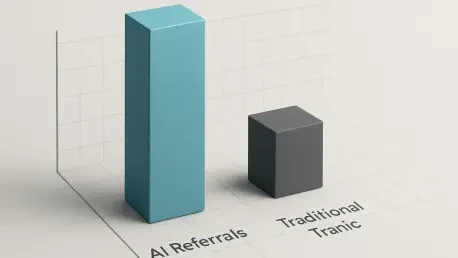

The digital marketplace has undergone a radical transformation this year, resulting in a staggering 138% surge in retail visits sourced directly through artificial intelligence platforms. This momentum positions tools like OpenAI’s ChatGPT and Google’s Gemini not just as experimental assistants, but as the primary architects of consumer discovery. Adobe and Shopify have tracked this evolution, noting that Large Language Models (LLMs) have matured into high-intent shopping intermediaries. Unlike the casual exploration seen in previous cycles, current traffic trends show that these AI agents are now the definitive gatekeepers of quality retail engagement, providing a more refined entry point than traditional organic search.
Understanding the Shift Toward AI-Driven Consumer Discovery
The current landscape represents a permanent change in consumer behavior, where the transition from keyword-based searching to dialogue-based discovery has accelerated. Data from Adobe Analytics confirms that retail traffic originating from AI sources reached its highest share in May 2026, surpassing all monthly records from the previous year. This growth is driven by the integration of real-time browsing capabilities within LLMs, which allow users to receive synthesized product recommendations without sifting through pages of blue links.
Furthermore, the role of AI has moved beyond simple information retrieval into a phase of active shopping mediation. Platforms like Gemini and ChatGPT Search are now functioning as personalized concierges that vet products before a user ever lands on a merchant’s site. This shift means that by the time a visitor arrives via an AI referral, the initial “discovery” phase is already complete. Consequently, these shoppers are arriving with much higher intent, fundamentally changing the nature of the traditional sales funnel for retailers.
Comparing High-Intent AI Referrals and Standard Traffic Channels
Evaluating Conversion Efficiency and Revenue Generation
Financial performance metrics show a widening gap between AI-driven traffic and standard acquisition channels. According to Adobe, AI-referred visitors generated 53% more revenue per visit in May 2026 compared to non-AI sources. This efficiency is mirrored in conversion rates, which are now 54% higher for shoppers coming from AI platforms. This represents a massive reversal from 2025, when AI visitors initially converted at only half the rate of traditional visitors because the technology was still being used for general inquiries rather than specific commerce.
Analyzing User Engagement and Session Stability
Behavioral metrics further illustrate the superior quality of the AI-referred audience. These shoppers spend 53% more time on retail websites and view 23% more pages per visit, indicating a deeper level of brand exploration. Session stability is also notably higher; bounce rates for AI traffic remain remarkably low, ranging between 17% and 20%. In contrast, traditional traffic channels suffer from higher bounce rates averaging around 27%, suggesting that AI does a better job of matching the right consumer to the right product catalog.
Examining Navigation Patterns and Path-to-Purchase Logic
Navigation patterns reveal a “Direct-to-Product” logic that bypasses the traditional homepage-centric journey. Shopify data indicates that more than 50% of AI-referred sessions begin directly on a product detail page, compared to only 20% for organic search traffic. This happens because AI assistants analyze product specifications and reviews in the background, sending the user exactly where the purchase happens. The AI effectively performs the filtering and vetting process, delivering a consumer who is ready to buy rather than one who is just starting to browse.
Technical Hurdles and the Challenge of AI Readability
Despite the benefits, retailers face significant obstacles in making their digital catalogs accessible to AI agents. Adobe’s research points to a disparity in machine readability; while blogs and homepages often score around 75% for AI accessibility, product detail pages lag at approximately 66%. This gap exists because many e-commerce sites still prioritize visual aesthetics for humans over structured data for machines. To succeed, brands must transition from traditional Search Engine Optimization to AI Optimization (AIO), emphasizing structured data schemas over simple keyword density.
The technical friction of the checkout process is also being addressed through new cross-platform standards. Google’s implementation of the Universal Commerce Protocol has been a pivotal development in reducing the steps between discovery and purchase. This protocol allows for a seamless transition from a Gemini conversation to a final transaction, effectively removing the barriers that once led to abandoned carts. For retailers, the challenge is no longer just about ranking high on a list, but about ensuring their data is clean enough for an AI agent to interpret and trust.
Strategic Recommendations for the AI-First Retail Era
The massive elevenfold increase in search-driven orders reported by Shopify underscores the necessity of a dedicated AI strategy. Retailers should prioritize the optimization of their product discovery pages, ensuring that buying guides and technical specifications are presented in formats that AI crawlers can easily parse. Because ChatGPT Search recommendations are viewed as more objective than paid advertisements, building organic authority within these ecosystems is now more valuable than traditional pay-per-click campaigns for long-term brand trust.
The shift toward AI-first commerce required brands to rethink their digital infrastructure to support automated agents. Successful companies focused on enhancing machine readability scores and adopted the Universal Commerce Protocol to facilitate frictionless checkouts. By catering to the high-intent nature of AI-referred shoppers, these retailers positioned themselves to capture a demographic that spent more and stayed longer than traditional visitors. Ultimately, the maturation of these platforms transformed the digital storefront into a responsive partner for the next generation of online consumers.