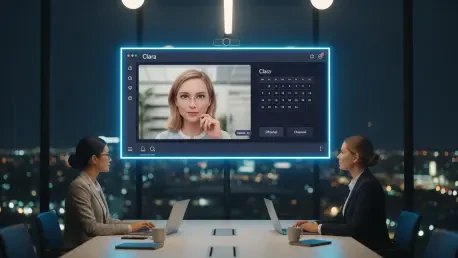

Milena Traikovich has spent her career turning anonymous interest into measurable pipeline. As a demand generation leader steeped in analytics and performance optimization, she helped shape Clara, TruGen AI’s always-on AI Sales Rep. Clara engages visitors with a human-like face and voice, runs adaptive demos, qualifies in real time, and books meetings—across Zoom, Microsoft Teams, Slack, and email—while learning from every interaction through an Organizational Memory Graph. In this conversation, Milena unpacks how human-like conversations are designed without crossing ethical lines, the mechanics behind adaptive demos and rigorous qualification, what drives up to 10x conversion lifts versus the 3–5x market norm, how multilingual brand voice and enterprise security are enforced, and what a five-year forecast looks like as AI teammates take on up to 40% of sales tasks.
Clara engages visitors 24/7 with a human-like face and voice. What specific conversational cues and demo tactics make that feel natural, and how do you prevent uncanny or pushy behavior? Can you share design iterations that boosted trust or time-on-site metrics?
We anchored Clara’s presence in subtle human cues: micro-pauses before answering, brief recap statements after complex replies, and lightweight visual feedback—head nods and eye focus that signal active listening without veering into theatrics. On the demo side, Clara never “front-loads” a pitch; she asks permission to proceed, offers two or three paths, and mirrors the visitor’s own language back to them, which keeps momentum without pressure. To avoid the uncanny valley, we tuned prosody to avoid over-enthusiasm and inserted natural disfluencies only in low-stakes transitions—think “let me pull that up”—never in core explanations. An early iteration greeted users with a lengthy opener and actually reduced time on site; trimming the opener to a concise context set and offering an immediate choice of “quick overview” or “deep dive” lifted average engagement while keeping it comfortably human, not pushy.
You claim autonomous product demos adapt by role, industry, and expressed needs. How does the system detect those attributes in real time, and what fallback logic kicks in with sparse signals? Walk us through a concrete example from click to booked meeting.
Clara starts with first-party signals—referrer, UTM tags, the page path—and blends them with conversational intent detection. If a visitor mentions “renewals forecast,” Clara infers a revenue ops lens; if they say “data residency,” a compliance path lights up. When signals are thin, Clara asks one or two lightweight clarifiers—“Are you exploring this for healthcare or fintech?”—and if the user declines, she switches to a role-agnostic core demo that still personalizes by the page they landed on. Picture this: a visitor clicks from a pricing page at midnight, mentions “Teams support,” and asks about objection handling. Clara shows a two-minute sequence highlighting Microsoft Teams, demonstrates real-time objection handling, confirms meeting preferences, and books directly onto the team calendar—no forms, no delays—while logging the full context for the AE.
Early users report up to 10x conversion from traffic to qualified pipeline, while market benchmarks point to 3–5x gains. What underlying conditions produce the top end of that range, and where do results plateau? Which diagnostic metrics do you monitor weekly?
The up-to-10x outcomes tend to appear where two conditions intersect: high-intent traffic that previously leaked due to forms and delayed follow-up, and a clear, objection-heavy buyer journey where instant, informed responses change the game. We see plateaus when traffic skews educational rather than commercial or when pricing authority is tightly gated and can’t be previewed. Weekly, I watch conversation-to-demo progression, demo completion, objection resolution rate, meeting acceptance, and qualified pipeline yield by source. Those, plus the delta between after-hours and business-hours conversion, tell me whether the 24/7 promise is translating into real, compounding wins.
Clara handles objections, qualifies leads, and books meetings. How do you encode objection-handling playbooks without sounding canned, and what guardrails keep qualification rigorous? Describe the scoring rubric and a real case where it prevented a false positive.
We encode objections as layered patterns, not scripts: intent recognition triggers a response framework—acknowledge, contextualize, evidence, optional proof—while Clara pulls examples from the Organizational Memory Graph to keep phrasing varied and brand-aligned. Qualification guardrails require Clara to confirm problem fit and timeline before proposing a meeting; if either is ambiguous, she asks for clarity or routes to a resource center. Our rubric weighs need clarity, authority signals, solution alignment, and urgency; a minimal passing threshold demands strength across all, not just one shining attribute. In one case, a visitor loved the demo but hinted they were researching for a “course project”; Clara logged interest, shared resources, and withheld a qualified status—no vanity pipeline, just honest signal.
The AI can join Zoom or Teams, post in Slack, and send autonomous emails. How do you orchestrate handoffs across these channels without fragmenting the buyer’s journey? Share the workflow logic and logging practices that preserve context end-to-end.
We treat channels as surfaces on one thread, not separate conversations. Clara maintains a canonical interaction record, so when she shifts from web to email or joins Zoom or Microsoft Teams, she carries the last confirmed intent, objections handled, and assets shared. Handoffs follow a simple rule: highest-signal channel owns the next step—if a meeting is booked, the calendar event becomes the spine, and Slack updates reference that spine, not the other way around. Every transition appends a short state summary—what was asked, what was promised, what remains—so AEs and prospects experience continuity rather than a stitched-together set of messages.
Multilingual engagement promises global coverage across time zones. How do you maintain brand voice and legal accuracy across languages, and what’s your process for localization QA? Give examples where regional norms required different sales tactics.
We separate message intent from phrasing: Clara holds brand tenets—tone, formality, claims boundaries—and renders them per language with locale-specific style guides. For legal accuracy, claims are template-locked and reference a vetted corpus, which is especially important for regions operating under GDPR. Localization QA pairs bilingual reviewers with test transcripts from live flows, validating tone and terminology before rollout. Tactically, we’ve seen more indirect objection framing resonate in some markets, where Clara asks permission to share a counterpoint first, while in others a crisp, evidence-led response lands better; the goal is cultural fluency without deviating from brand truth.
Many teams fear losing the “human touch” in high-stakes cycles. Where do you deliberately route to a human, and what signals trigger escalation? Outline the playbook for a complex enterprise deal with shared ownership between AI and AE.
We escalate when conversations move into multi-stakeholder alignment, bespoke pricing, or sensitive change management—areas where nuance and trust-building are paramount. Triggers include references to executive sponsorship, custom security reviews, or procurement timelines. The playbook has Clara assemble a concise brief—stakeholders named, objections cleared, assets consumed—and hand the thread to the AE while staying available for follow-ups, scheduling, and artifact delivery. That way, humans handle strategy and relationship depth, while Clara keeps the mechanics frictionless and responsive.
Predictions suggest a large share of B2B interactions will be AI-mediated soon, and 40% of sales tasks could be automated. Which SDR tasks should be automated first, which should never be, and how should leaders phase the transition? Include training steps and KPIs.
Start with repetitive, time-sensitive work: rapid response, meeting scheduling, initial qualification, and follow-up reminders—areas where 24/7 coverage and consistency shine. Don’t automate discovery that hinges on delicate organizational dynamics or anything requiring judgment about internal politics. Leaders should phase with pilot segments, pair SDRs with Clara as a co-pilot, and shift to shared quotas that reward human-AI collaboration. Train teams on playbook design and conversation review, and track time-to-first-response, meeting acceptance, qualified pipeline created, and post-meeting satisfaction to ensure automation is raising the bar, not lowering it.
The “Organizational Memory Graph” promises compounding intelligence. What data types feed it, how do you prevent concept drift, and how do you version institutional knowledge? Walk us through rollback procedures after a bad learning event.
The graph ingests product facts, competitive insights, objection patterns, case studies, and outcomes—what worked, what didn’t—so Clara can connect context to results. To curb drift, we partition evergreen truths from time-bound tactics and require review before anything overwrites core knowledge. Versioning is explicit; every knowledge change is tagged by source, time, and scope. If a bad learning event slips through, we pin the last good version, revert Clara’s active corpus, flag affected interactions for AE review, and replay future conversations against the corrected baseline to restore consistency fast.
Competitors span conversational sales platforms and video avatar tools. Where does the real defensibility come from: models, data network effects, integrations, or workflow depth? Share a head-to-head scenario that exposed a meaningful gap.
Defensibility is the fusion layer—workflow depth anchored by an Organizational Memory Graph—because that’s where conversations turn into outcomes. Models can be swapped; depth of integration and the way learnings compound are harder to copy. In one head-to-head, a rival delivered a slick avatar but defaulted to one-way tours and handoffs that lost context. Clara held a two-way dialog, adapted the demo in real time, handled objections, and booked the meeting—thread intact—proving that cohesion across steps beats surface-level polish.
Human-like avatars raise transparency and ethics questions. How do you disclose AI status without breaking immersion, and what language has tested best? Describe policies for recording consent, storing media, and addressing misrepresentation risks.
We state clearly, upfront, that “I’m Clara, an AI sales teammate here 24/7,” and reinforce it visually so there’s no ambiguity. That phrasing keeps immersion—role and availability—while honoring transparency. Consent policies are straightforward: explicit consent for recording on calls, easy opt-outs, and clear notices when storing transcripts or media. To prevent misrepresentation, Clara avoids personal claims a human would make and anchors statements in verifiable sources; if a question is out-of-policy, she discloses limits and offers a path to a human.
Security certifications include SOC 2, HIPAA, ISO 27001, and GDPR. Which controls directly impact daily sales operations, not just audits? Detail your data flow maps, retention windows, and how customers verify that “no training use” is truly enforced.
Day to day, access controls and audit trails matter most—who saw what, when, and why—because they govern every shared deck and transcript. Our data flow maps show intake from web, Zoom or Microsoft Teams, Slack, and email into processing, then into the Organizational Memory Graph with role-based visibility. Retention aligns with customer policy; data is kept only as long as it’s needed for active selling and support, then purged. The “no training use” clause is enforced by isolating customer content from general model training, and customers can verify via contract terms and reviewable logs that confirm no cross-tenant use.
Performance depends on initial training data quality. What’s the minimum viable corpus to launch, and how do you bootstrap when assets are messy or scarce? Provide a step-by-step data hygiene and enrichment plan with timeline and owners.
A lean corpus—core product facts, a handful of case studies, common objections with answers, and brand tone—gets you live, especially because Clara can learn from new interactions. When assets are messy, start with a quick audit to separate canonical truths from outdated material, then normalize language to align with brand voice. Next, encode objection frameworks and verify claims, particularly for regulated regions that require GDPR awareness. From there, run a soft launch, capture early questions, and fold high-signal learnings back into the graph so quality compounds without waiting for a perfect library.
Leaders worry about shadow IT when an AI touches calendars, CRMs, and messaging apps. How do you manage least-privilege access, secrets rotation, and incident response across tenants? Share the runbook for a simulated compromise.
We provision Clara with the smallest set of permissions to complete tasks—calendar write for booking, read-only where appropriate, and scoped CRM access for qualification fields—nothing more. Secrets rotate on a regular cadence and are isolated per tenant. Our incident runbook starts with containment—revoke tokens and cut off affected integrations—followed by log review, customer notification, and restoration from clean states. Post-mortem, we tighten scopes and update detection rules so the same path can’t be exploited twice.
Teams may replace some SDR roles while elevating others. What new skills and roles emerge—AI playbook designer, conversation analyst, agent wrangler—and how should compensation and career paths evolve? Include a 90-day reskilling curriculum.
We’re seeing three roles rise: AI playbook designers who translate strategy into conversation flows, conversation analysts who mine transcripts for insight, and agent wranglers who tune Clara in production. Compensation should reward shared outcomes—human plus AI pipeline and revenue—so collaboration isn’t a tax on earnings. A 90-day reskill can cover brand and objection frameworks, hands-on playbook building, analysis of real transcripts, and operational basics like security and consent. Graduates move into higher-leverage roles that shape many conversations at once, not just one call at a time.
What is your forecast for AI sales teammates over the next five years?
We’re moving toward a world where AI is the first responder in most B2B interactions, with humans steering strategy, empathy, and complex orchestration. By the time today’s mid-cycle deals are up for renewal, buyers will expect instant, accurate answers at any hour, and teams that deliver will compound advantage quickly. With predictions that half of interactions could be AI-mediated and up to 40% of sales tasks automated, the opportunity is to redesign roles so people do the work only people can do. My advice to readers: start now—pilot responsibly, measure relentlessly, and teach your teams to collaborate with AI as a true teammate, not a tool.