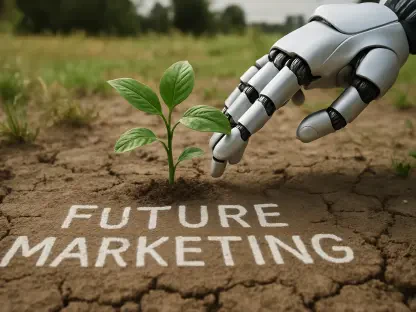

The modern Chief Marketing Officer operates at a difficult crossroads, charged with delivering measurable growth while grappling with escalating operational costs, fragmented data sources, and a bewilderingly complex technology landscape. In this high-pressure environment, a new class of technology is emerging not merely as an assistant, but as an autonomous executor of strategy: agentic AI. This evolution represents a fundamental shift from tools that automate single tasks to intelligent systems designed to manage and optimize multifaceted marketing campaigns on their own. This analysis will explore the key forces propelling this trend, showcase its application through pioneering platforms like Kana, incorporate insights from industry veterans, and project the future of a truly AI-native marketing function.
The Accelerating Rise of AI Agents in Marketing
The Data and Demands Driving Adoption
The push toward AI-driven strategies has become a primary mandate for marketing leaders, yet it often comes with the contradictory demand to reduce operational expenses. CMOs are caught between the need to innovate and the pressure to deliver efficiencies, all while navigating a marketing technology stack that has grown increasingly convoluted. The sheer volume of tools required for analytics, advertising, and customer relationship management creates operational friction, making a unified, intelligent approach more of a necessity than a luxury.
This demand is amplified by significant industry-wide challenges that undermine traditional marketing effectiveness. First-party data, the lifeblood of personalization, is frequently trapped in organizational silos, preventing a holistic view of the customer journey. Furthermore, the decreasing transparency from dominant advertising platforms like Google and Meta has created “walled gardens,” making it harder for marketers to gain clear insights into campaign performance and audience behavior. Agentic AI emerges as a direct response to this complexity, offering a way to intelligently bridge these data gaps and navigate opaque ecosystems autonomously.
Agentic AI in Action The Kana Platform
The theoretical promise of agentic AI is being made concrete by platforms like Kana, an AI-native marketing engine designed to accelerate growth by automating both strategic and administrative work. Rather than functioning as a passive tool, Kana deploys a suite of purpose-built AI agents that actively manage and execute marketing initiatives. This system is engineered to function as a core intelligent layer, interfacing with a company’s existing data and technology to drive outcomes.
The platform’s applications demonstrate the breadth of its capabilities. Its agents can conduct automated media planning by analyzing historical performance data to allocate budgets effectively. They also perform real-time campaign optimization, delivering actionable recommendations to improve performance as it unfolds. Beyond advertising, Kana can generate high-quality synthetic data, enabling robust market research and enhanced personalization without compromising user privacy. The system also automates labor-intensive tasks like creating RFP responses and proposals and provides Answer Engine Optimization (AEO) to ensure a brand’s visibility in the new landscape of AI-powered search results.
Expert Perspectives on the AI Native Revolution
The vision behind platforms like Kana is backed by deep industry experience. Serial entrepreneurs Tom Chavez and Vivek Vaidya, the founders of Kana, have a proven track record of identifying and solving critical marketing challenges. Their previous ventures, Rapt (acquired by Microsoft) and Krux (acquired by Salesforce), were instrumental in shaping earlier eras of marketing technology. This history lends significant credibility to their current focus on agentic AI as the next evolutionary step for the industry.
This sentiment is echoed by investors who see the transformative potential of this technology. Navin Chadda, Managing Partner at Mayfield, emphasizes that the founders’ expertise uniquely positions them to build the definitive platform for the AI-native era. He frames agentic AI not as just another tool, but as the essential “intelligent layer” that will power the future of marketing teams. This perspective underscores the belief that agentic systems will become as fundamental to marketing as CRM or analytics platforms are today.
The Future Trajectory of Intelligent Marketing
One of the most immediate impacts of agentic AI is the dramatic compression of execution timelines. Innovations like Kana’s proprietary Just-In-Time Data Integration technology allow its agents to dynamically connect with and structure data from disparate marketing and media systems. Consequently, complex tasks that once required days or even months of manual effort, such as multi-channel campaign planning or in-depth performance analysis, can now be completed in a matter of minutes or hours.
Crucially, this acceleration does not come at the expense of human control. The prevailing model for this technology is one of “augmented intelligence,” where the AI serves as a powerful collaborator rather than a complete replacement. This framework ensures that human oversight is maintained at every critical step. Users can review, refine, and approve all AI-generated outputs—from media plans to creative briefs—before they are deployed. This human-in-the-loop system preserves quality control and strategic alignment while harnessing the speed and scale of AI.
The broader implication is that agentic AI is a non-disruptive but deeply transformative technology. Instead of forcing companies to rip and replace their existing infrastructure, platforms built on this model connect seamlessly with the systems and data sources teams already use. This approach empowers marketing departments to become more agile and strategic without enduring the pain and cost of a massive technological overhaul, making the transition toward an AI-native future both accessible and practical.
Conclusion: Embracing the New Marketing Paradigm
The analysis showed that agentic AI has emerged as the definitive response to the immense pressures facing modern marketing organizations. It became clear through platforms like Kana that this technology was no longer theoretical but a practical and powerful tool for automating complex workflows and unlocking new growth opportunities. Its future trajectory pointed firmly toward a human-centric, augmented model, where AI handles the execution, allowing marketing professionals to focus on higher-level strategy and creative thinking.
Ultimately, the adoption of agentic systems was not merely about gaining an efficiency advantage; it was about fundamentally reshaping the marketing function. By embracing this new paradigm, leaders were able to navigate data complexity, overcome platform opacity, and maintain a competitive edge in a rapidly evolving digital landscape. The trend empowered a new generation of marketers to transition from being managers of tedious tasks to architects of intelligent, autonomous growth engines.