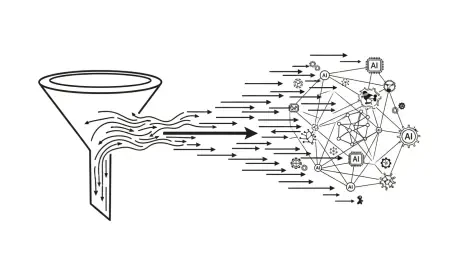

The historical reliance on a consumer’s patience to navigate through awareness and consideration has been replaced by an environment where algorithms decide before a human even blinks. Dentsu’s recent “Beyond the Funnel” research illuminates how the traditional linear customer journey has dissolved into a disruptive AI-integrated model. In this new landscape, algorithmic gatekeepers and Large Language Models (LLMs) take center stage, fundamentally altering how brands reach their targets.
While old-school funnels prioritized human awareness, the shift toward Agentic Commerce emphasizes machine-led execution and rapid data synthesis. These modern ecosystems function as filters that process information at speeds no human could replicate, making the old awareness-to-purchase path feel like a relic. The purpose of these models is to facilitate a commerce environment where data provides the roadmap for autonomous action.
Evolution from Traditional Marketing to AI-Driven Decision Ecosystems
The transition from manual consumer journeys to AI-driven ecosystems represents a total departure from traditional marketing logic. In the past, companies spent years perfecting the art of catching a human eye; however, the Dentsu research group highlights that the real audience now consists of LLMs and algorithmic gatekeepers. These entities act as the primary filters for information, deciding which brands even make it to the digital shelf.
Traditional funnels focused on nurturing human sentiment over long periods, but Agentic Commerce prioritizes the immediate synthesis of data to drive execution. This evolution means that the gatekeepers are no longer just search engines but sophisticated agents that evaluate a brand’s entire digital footprint in milliseconds. Consequently, the priority has shifted from simple brand visibility to becoming a preferred data point for a machine.
Core Pillars of Consumer Interaction and Brand Discovery
Structural Differences in the Customer Journey
The classic multi-stage funnel—built on the pillars of awareness, consideration, and conversion—stands in profound contrast to the collapsed timeline found in Agentic Commerce. Traditional models relied on a slow burn, dragging consumers through manual exploration and multiple touchpoints before reaching a decision. In contrast, AI-driven systems merge these distinct phases into a single, instantaneous event.
This structural shift moves the market away from a series of psychological steps toward a world where purchase intent and execution occur simultaneously. When an agent acts on behalf of a user, the period of consideration effectively vanishes. The brand that wins is the one that has already been vetted and validated by the system long before the transaction is initiated.
Active Manual Comparison vs. Passive Algorithmic Selection
Finding a product used to involve active brand comparison where users weighed features and prices themselves across various platforms. Today, users have transitioned into a state of passive reception, accepting options curated by sophisticated AI systems that anticipate their needs. The “Beyond the Funnel” report identifies LLMs as the new gatekeepers that aggregate and rank brands before a search query is even finalized.
This change removes the burden of choice from the individual, placing it squarely in the hands of algorithms that analyze digital signals with ruthless efficiency. Brands that fail to optimize for these selection criteria find themselves invisible to the consumer, as the agent only presents the most relevant, high-probability options. The era of the “uninformed” shopper has been replaced by the “agent-led” buyer.
From Demand Generation to Decision Readiness
Linear funnels were designed primarily to generate human attention, treating visibility as the ultimate prize in a crowded marketplace. Agentic systems, conversely, focus on the concept of decision readiness. The strategy for brands shifted from fighting for a split second of visibility to ensuring they are viewed as the most reliable and relevant choice by autonomous agents.
This readiness depends on a brand’s ability to present itself as a logical, low-risk solution for an AI to select on behalf of its user. Instead of screaming for attention, the successful brand communicates its value through consistent, high-quality data signals. The focus is no longer on making a person want something, but on making it inevitable that an algorithm will pick it.
Implementation Hurdles and Operational Constraints
Transitioning to an AI-first model required more than just new software; it demanded a radical internal restructuring of the business itself. Organizations had to dissolve long-standing silos between marketing, data, technology, and sales departments to create a unified data stream. Technical difficulty arose in maintaining absolute data consistency, as even minor discrepancies in digital signals caused algorithms to filter brands out completely.
Furthermore, delegating choice to autonomous systems brought up ethical and practical questions regarding fairness and transparency. Brands discovered that while technology drove the process, human oversight remained necessary to maintain values that machines might overlook. The challenge lay in balancing the speed of autonomous execution with the need for a brand to remain trustworthy and transparent in its operations.
Strategic Recommendations for an AI-First Marketplace
The fundamental shift noted in the Dentsu research emphasized that market relevance depended on being optimized for algorithmic discovery. Businesses had to choose between focusing on AI Commerce, which assisted human choice, or Agentic Commerce, which handled autonomous execution. This framework required a commitment to data quality and operational transparency to ensure that both humans and agents viewed the brand as a trustworthy selection.
Strategic success relied on the ability to maintain consistent signals for Large Language Models across all digital touchpoints. Companies that prioritized these technical and operational alignments secured their place in the new ecosystem. Ultimately, the transition proved that the brands capable of becoming “decision-ready” for machines were the ones that maintained dominance in a marketplace where the human funnel had finally collapsed.