
Budgets once scattered across dozens of niche martech apps are now collapsing into code-as-prompt workflows, as vibe coding lets marketers and engineers rebuild point tools in days for pennies on the dollar. The shift is not subtle; it changes how stacks are planned, how vendors compete, and how outcomes are measured. As feature parity spreads, the strategic center moves from buying many tools to composing a few governed workflows on top of durable platforms.
Market Context and Purpose
This analysis examines how AI-assisted, prompt-driven creation by both developers and non-developers is redrawing the martech map. The goal is to clarify why edge utilities are being rebuilt or removed, which platforms retain control, and how value migrates from software features to services, integration, and governance.
Several forces now converge. Daily use of AI coding among U.S. developers is widespread, a significant share of code globally is machine-generated, and most vibe coding users are not formal developers. That combination expands in-house production capacity well beyond engineering teams, converting previously purchased capabilities into internal builds. The practical outcome is a measurable decline in renewals for single-function tools and a consolidation of spend into orchestration platforms and systems of record.
The purpose of this report is to map the competitive realignment, quantify adoption signals, and offer an outlook on pricing, procurement, and operating models. The intent is not to predict a single path but to outline the dynamics that drive vendor churn at the edges and reinforce platforms at the center.
Demand Shifts and Stack Realignment
A decade of best-of-breed expansion brought sprawling stacks orbiting CRMs and marketing automation suites. Differentiation lived in features and speed; replacement meant swapping one app for another. Vibe coding compressed that playbook. When prompts, examples, and enterprise context can recreate many capabilities quickly, the marginal value of a standalone feature declines.
Data confirms the turn. Mid-market organizations report a 35% year-over-year drop in renewals for single-purpose tools, and agencies recount replacing roughly 80% of subscriptions with AI-built utilities that fit internal workflows. An $18 billion market for vibe coding platforms lowers the hurdle to compose, test, and iterate, helping buyers translate perceived parity into real savings.
However, not all layers move at the same pace. Systems that bind data, process, and action—lead routing, pipeline management, campaign orchestration, and personalization—retain stickiness. Switching those cores entails reconfiguration risk, retraining costs, and data integrity concerns that a quick prompt cannot offset. The result is a bifurcated stack: fluid edges, durable centers.
Edge Commoditization: From Replacement to Removal
The creation tier—copy, visuals, decks, lightweight analytics, rapid insights—has become the fastest-moving segment. Imperfect AI-generated code proves “good enough” across many workflows, and human-written code was never perfect. As replication time falls from quarters to days, buyers question the logic of paying for point solutions whose value can be reproduced on demand.
Consequently, the decision set changes. Rather than compare Vendor A to Vendor B, teams ask whether the category should exist at all. Internal builds deliver tighter process fit and lower marginal costs, but they shift responsibility for governance, testing, and lifecycle management inside the organization. That trade-off is manageable for utilities with limited blast radius; it is less tenable where uptime, cross-functional SLAs, or audit trails are non-negotiable.
Platform Resilience: Data Gravity and Orchestration
Core platforms endure because their advantage is not a single feature; it is the coupling of data models, permissions, workflows, and user habits. Migrating a system of record risks downtime and breaks historical continuity, which can distort attribution, forecasting, and compliance reporting. Those costs outweigh incremental feature gains from challengers.
This resilience reframes vendor strategy. To remain indispensable, platforms deepen integration, extensibility, and governance, becoming policy anchors for identity, consent, lineage, and model controls. By publishing robust APIs, reference architectures, and safe sandboxes, they invite customers to build on them rather than around them, turning vibe coding from a threat into a force multiplier.
Regional Nuance, Compliance Pressure, and Misreads
Market behavior varies by region and sector. In jurisdictions with strict data residency or industries with rigorous audit demands, internal builds face steeper security reviews and documentation requirements. In those contexts, certain edge tools survive longer due to proven compliance and predictable SLAs.
Common misreads still surface. AI-generated code does not eliminate quality controls; variability increases the need for reviews, testing harnesses, dependency management, and secure pipelines. Nor does universal in-sourcing make sense. Mission-critical integrations with formal uptime guarantees often remain better served by mature vendors or platform-native modules. The pragmatic stance is composability: keep the orchestrators, rebuild the edges that are safe to own, and govern everything.
Data Signals and Forecast
Adoption intensity is unambiguous: daily AI coding among developers is near-ubiquitous, roughly 41% of global code is machine-generated, and non-developers account for about 63% of vibe coding users. Those numbers explain why the build capacity of go-to-market teams surged without proportional headcount growth.
Market consequences follow. Renewal declines at the edges point to a contracting addressable market for narrow point solutions. Pricing gravitates toward usage and services, with buyers favoring tools that verify outcomes and reduce total cost of ownership. Procurement scrutiny tightens, and proof of value shifts from feature checklists to measurable impact on pipeline, CAC, retention, and cycle time.
Over the next budget cycles, three trajectories dominate. First, removal overtakes replacement at the edges, trimming long-tail vendors as internal utilities proliferate. Second, orchestration platforms consolidate governance—policy, consent, lineage, and model controls—to secure their role as the operating system of the stack. Third, regulators emphasize transparency and data minimization, elevating vendors with auditable processes and resilient security postures.
Competitive Landscape: Platforms, Governance, and Services
Feature-based differentiation continues to collapse as replication windows narrow. Vendors that compete purely on functionality confront a field of look-alike offerings and buyers capable of assembling bespoke alternatives. Survival tilts to the surround: implementation services, solution engineering, security stance, compliance depth, integration reach, and customer success.
For buyers, a lightweight software factory becomes essential. Pair prompt-savvy builders with operations leads, enforce code review and documentation, standardize event schemas, and anchor identity and consent in the core platform. Risk management shifts left: dependency scanning, secrets management, model drift monitoring, and incident runbooks become routine.
Operating models adjust accordingly. Agencies productize playbooks and co-managed services; platforms monetize governance and extensibility; point vendors evolve into specialists for regulated domains or embed as modules within larger ecosystems. The common denominator is accountability for outcomes and a demonstrable reduction in operational drag.
Strategic Implications and Next Moves
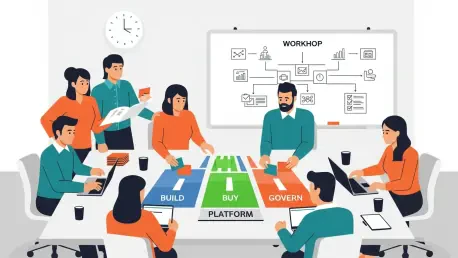
The analysis pointed to a structural rebalancing: creative and utility layers became fluid, while systems of record and orchestration stayed anchored by data, workflows, and training. Value migrated off features and onto integration trust, expert services, strong governance, and measurable outcomes. Buyers that mapped stacks by “build, buy, govern” cut spend at the edges without jeopardizing reliability, and vendors that leaned into the surround preserved relevance despite feature parity.
Actionable next steps centered on four moves. First, codify a composability plan that identifies safe-to-build utilities, platform-first integrations, and governance checkpoints. Second, invest in an internal software factory with testing, documentation, and security controls designed for citizen developers. Third, tie every tool—purchased or built—to revenue and efficiency metrics, and sunset anything that could not prove lift. Fourth, insist on auditable data lineage and model controls, turning platforms into policy engines rather than mere feature suites.
Taken together, these steps translated the promise of vibe coding into durable business results, minimized technical debt, and repositioned stacks for faster cycles with lower risk.