
Milena Traikovich is a seasoned expert in demand generation who specializes in transforming how businesses nurture high-quality leads through sophisticated analytics and performance optimization. With her extensive background in lead generation initiatives, she has become a pivotal voice in the conversation about ecommerce efficiency and consumer behavior. In this discussion, we examine the shifting dynamics of the online fashion world, focusing on the massive gap between digital and physical storefronts and how emerging technology is finally addressing the high return rates and low conversion metrics that have traditionally hindered growth. We will explore the critical role of virtual fitting rooms, the specific impact of AI on luxury segments, and the long-term retention strategies that are keeping shoppers engaged far beyond their initial click.
Online fashion platforms often struggle with conversion rates as low as 1%, while physical stores see numbers closer to 30%. What specific hurdles do digital brands face that prevent them from matching the success of brick-and-mortar locations?
The primary challenge lies in the sensory gap that exists when a shopper is separated from the physical product. In a traditional retail environment, conversion rates soar between 23% and 30% because customers can interact with the garment, feeling the weight of the fabric and seeing exactly how a silhouette complements their unique body shape. Online, we are essentially asking consumers to make a financial commitment based on static images and generic model photography, which leads to a lackluster average ecommerce conversion rate of just 1.65%. This lack of tactile information creates significant hesitation, contributing to the industry’s staggering 30% to 40% return rates as shoppers “bracket” their purchases or simply find that the reality doesn’t match the digital promise. Without a way to evaluate fit and styling in real-time, the digital experience feels like a gamble rather than a curated shopping journey.
With the introduction of AI-powered virtual try-on tools, how are we seeing the sales funnel change for brands that move beyond static product photography?
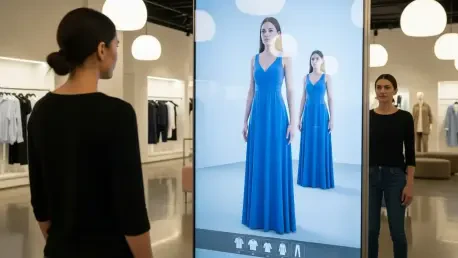
The data reveals a dramatic shift in how shoppers move from discovery to purchase when they have access to interactive try-on features. For instance, we see that users engaging with these tools convert from a product view to a shopping cart at a rate of 11%, which is a massive leap compared to the 4% seen among non-users. This isn’t just about filling a cart; the actual purchase conversion rate for try-on users sits at 3%, representing a 50% increase over those who don’t use the feature. It turns the passive act of scrolling into an active, participatory experience where the customer becomes the model, using silhouette mapping and fabric modeling to gain the confidence needed to hit the buy button. By providing this level of visual validation, brands are effectively bridging the gap between “just looking” and “must have.”
Luxury fashion is often defined by its exclusivity and high price points. How does virtual try-on technology specifically influence the behavior of shoppers looking at premium or high-ticket items?
In the luxury segment, the impact of virtual try-on is even more pronounced because the financial stakes for the consumer are so much higher. We found that for products priced above $1,000, engagement with try-on features jumps to 27%, as opposed to a mere 4% for items under $50. Shoppers use these tools as a critical risk-validation step; for example, in luxury ecommerce, the view-to-purchase conversion reaches 2.8% for try-on users, while those without the tool convert at a dismal 0.3%. High-end brands like Victoria Beckham and Pascal are seeing that when a customer can see a garment’s specific fabric behavior and how it sits on their specific skin tone or body type, they are far more likely to finalize that thousand-dollar transaction. It transforms the luxury digital storefront from a gallery of unattainable images into a personalized atelier.
Customer loyalty is notoriously difficult to maintain in a crowded digital marketplace. What does the data suggest about how interactive experiences impact long-term retention and repeat visits?
The difference in retention between shoppers who use interactive tools and those who don’t is nothing short of extraordinary. By the first day after an interaction, 49% of try-on users remain active on the platform, while only 6% of non-users return. This engagement doesn’t just fade away; by Day 30, retention for try-on users holds steady at 44%, whereas the non-user group collapses to just 1%. We are also seeing a major surge in “power shoppers,” with 5% of try-on users returning more than ten times, compared to a negligible 0.4% among the control group. These tools create a reason for the customer to come back and explore, resulting in users viewing seven times as many product listings and completing 25% more searches than their counterparts.
As mobile shopping continues to dominate the market, what technical considerations must brands prioritize to ensure their virtual tools actually drive revenue?
Mobile is where the battle for the consumer’s wallet is being fought, with about 70% of shoppers engaging with try-on features via their phones. Interestingly, more than four out of five revenue dollars attributed to these tools come from mobile users, who actually purchase 12% more often than desktop users. However, this success is heavily dependent on the smoothness of the user experience, particularly the photo upload flow and the initial loading times. If the interface feels clunky or the generative AI takes too long to render the garment, the shopper will abandon the process instantly. Brands must ensure their systems are optimized for mobile-first interactions, as this is the primary environment where users choose between a Full-Body Try-On or an AI Twin to validate their style choices.
What is your forecast for the role of first-party data generated through these virtual interactions in the coming years?
My forecast is that the data harvested from virtual try-on sessions will become the most valuable asset in a fashion brand’s marketing arsenal. Instead of relying on broad demographics, retailers will use specific insights—such as which fits a customer prefers or which styles they repeatedly test—to fuel hyper-personalized product matching and merchandising. We are moving toward a model where brands will track user cohorts across 30, 60, and 90-day periods to see exactly how these interactions influence lifetime value. By analyzing these deep behavioral patterns, companies can move away from “one-size-fits-all” marketing and instead offer recommendations that feel uniquely tailored to the individual’s aesthetic and physical proportions. This level of personalization will eventually become the standard expectation for every digital consumer, making virtual try-on an essential component of the ecommerce infrastructure.