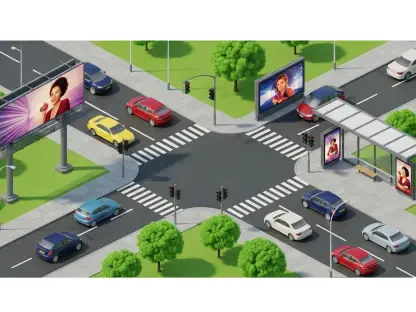

The skyline of Dubai and the bustling streets of Riyadh are no longer just architectural marvels; they have become high-tech canvases where data and creativity intersect in real-time. This digital metamorphosis is driven by the rapid ascent of Programmatic Digital Out-of-Home (prDOOH) advertising, a medium that has fundamentally altered the commercial fabric of the Middle East. As the region solidifies its position as a global hub for innovation, marketers are moving beyond the limitations of static billboards to embrace automated, auction-based buying. This shift represents a transition from a passive broadcasting model to an active, intelligence-led ecosystem that thrives on the pulse of urban life.
A New Era for Digital Out-of-Home Advertising in the Middle East
The current advertising environment in the Middle East is defined by a fierce pursuit of efficiency and measurable impact. Brands are increasingly moving away from traditional, rigid purchasing cycles toward a more fluid, automated approach. At the center of this change is the UAE, Saudi Arabia, and Qatar, where massive infrastructure investments have created a dense network of premium digital screens. These screens are now fully integrated into the programmatic pipeline, allowing for the same level of targeting precision found in online display ads but on a much grander, public scale.
This transformation is not merely about replacing paper with pixels; it is about the intelligence behind the image. By utilizing sophisticated supply-side platforms, regional advertisers can now bid for specific impressions in real-time. This ensures that a luxury brand’s message appears only when its target demographic is likely to be present, rather than running on a continuous, unoptimized loop. As a result, the Middle East is bypassing several stages of traditional media evolution, leaping directly into a data-centric reality that aligns with international standards for transparency and performance.
The Evolution from Static Displays to Programmatic Precision
Historically, the outdoor advertising market in the Middle East relied on long-term commitments and a “one-size-fits-all” creative strategy. However, the maturation of digital infrastructure has rendered those old models obsolete. Today, approximately 88 percent of prDOOH activity across the region is integrated into broader digital buying platforms. This integration allows advertisers to manage their outdoor presence alongside their social media and search campaigns, creating a unified front that was previously impossible.
This shift toward precision is particularly evident in how budgets are being reorganized. Marketing leaders are no longer viewing outdoor ads as a separate, isolated expense. Instead, they are treating the digital screen as another endpoint in a comprehensive digital journey. This evolutionary leap has been supported by the emergence of curated marketplaces, which allow buyers to access high-quality inventory across multiple media owners through a single point of entry. By simplifying the procurement process, the region has unlocked a level of agility that allows brands to react to market shifts within minutes.
Strategic Advantages Fueling Market Growth
The Power of Flexibility and Real-Time Optimization
Flexibility has emerged as the most significant driver for the adoption of programmatic technology in the regional outdoor sector. In a market as dynamic as the UAE, the ability to pause or pivot a campaign instantly is a major competitive advantage. Roughly 67 percent of marketers in the region prioritize this flexibility, as it allows them to safeguard their budgets against unforeseen circumstances. Whether it is adjusting a message to reflect a sudden change in temperature or capitalizing on a trending local event, the programmatic model ensures that every dollar spent is contextually relevant.
Moreover, this real-time optimization extends to the logistical side of advertising. Traditional media often suffered from long lead times and high production costs. With prDOOH, the barriers to entry are significantly lower, enabling smaller brands to compete for premium space during specific windows of time. This democratization of the high-impact outdoor space has led to a more diverse and vibrant advertising landscape, where relevance and timing often outweigh the sheer size of the total marketing budget.
Dynamic Creative and Emotional Resonance
The implementation of Dynamic Creative Optimization (DCO) has introduced a layer of personalization that was once restricted to personal devices. By leveraging data triggers such as traffic density, flight arrival times, or live sports scores, brands can deliver content that feels tailor-made for the moment. Approximately 66 percent of regional professionals now utilize these triggers to build a stronger emotional bond with their audience. When a consumer sees an ad that acknowledges their current environment, the psychological impact is significantly higher than that of a generic message.
This emotional resonance is backed by neuro-marketing research which suggests that timely, contextually aware content generates higher levels of brand recall. In the Middle East, where community and public life are central to the culture, these high-impact screens serve as shared touchpoints. By making these touchpoints smarter and more reactive, brands are successfully moving from simple awareness into the realm of meaningful consumer engagement. This strategy effectively bridges the gap between high-reach visibility and personal relevance.
Integration Across the Digital Multi-Channel Journey
Modern marketing in the region now treats the physical world as an extension of the digital storefront. About 90 percent of brand campaigns in the Middle East now pair prDOOH with mobile or social media activations to create a cohesive loop. For example, a consumer might see a high-definition ad for a new fragrance on a digital screen in a high-end mall and then receive a promotional offer on their smartphone as they approach the store. This seamless handoff is powered by sophisticated location data and audience targeting.
The use of first-party data has become a critical component of this multi-channel strategy. Marketers are increasingly using their own customer insights to determine which screens to activate and at what times. By aligning outdoor visibility with specific product affinities and demographic profiles, the industry has turned the traditional billboard into a high-performance conversion tool. This level of synergy ensures that the brand remains top-of-mind throughout the consumer’s entire journey, from the commute to the point of purchase.
Future Trends and Technological Innovations
Looking ahead, the investment in programmatic outdoor media is expected to climb by 42 percent as regional markets continue to expand. A significant portion of this growth will be driven by the rise of private marketplace (PMP) models, which offer a more controlled and premium environment for ad placement. Additionally, we are seeing the start of “trigger-based” buying at scale, where advertisements are automatically served based on environmental factors like air quality or real-time foot traffic data.
Technological advancements in measurement are also set to redefine the industry. New methodologies are emerging that allow brands to track the direct impact of an outdoor ad on store visits and online conversions with unprecedented accuracy. As these tools become more accessible, the accountability of outdoor advertising will reach parity with other digital channels. This progress will likely encourage even more traditional brands to migrate their budgets toward programmatic solutions, further cementing the region’s status as a leader in ad-tech innovation.
Key Takeaways for Navigating the PrDOOH Landscape
To succeed in this evolving market, businesses must prioritize internal education and technological literacy. Current data indicates that 68 percent of firms are already investing in staff training to better understand programmatic workflows. Organizations should also look to diversify their funding sources, as a significant portion of growth is currently coming from diverted digital and traditional budgets. It is no longer enough to simply have a presence on a screen; the strategy must be backed by robust data sets and a clear understanding of the local urban flow.
Furthermore, brands should focus on developing “creative agility.” The ability to produce multiple versions of an ad that can be swapped out based on real-time data is essential for maximizing ROI. By leveraging curated marketplaces, advertisers can gain access to premium inventory while maintaining the transparency and control needed to protect brand safety. Navigating this landscape requires a blend of high-level strategic planning and the ability to execute rapidly in response to live data signals.
A Transformed Advertising Horizon
The rise of programmatic Digital Out-of-Home was a decisive turning point for the Middle East, signaling a departure from static traditions and the birth of a data-driven public square. By merging the undeniable impact of large-scale visual media with the precision of modern automation, the region established a new benchmark for global advertising. This evolution proved that the physical environment could be just as agile and measurable as the digital one. Industry leaders successfully navigated these changes by investing in localized expertise and sophisticated multi-channel strategies. As technology continued to advance, the focus shifted toward deeper personalization and more accurate attribution models, ensuring that outdoor media remained a dominant force in the regional marketing mix.