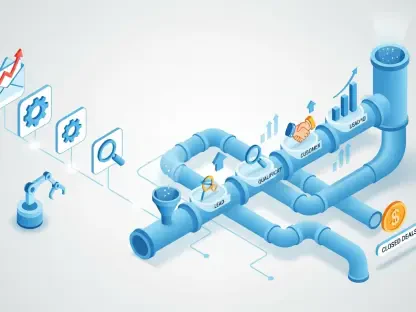

A significant portion of digital marketing expenditure fails to generate a proportional return on investment, a market inefficiency stemming from a long-held but increasingly flawed focus on traffic acquisition. An estimated 80% of brands misdiagnose stagnant growth, continuing to pour resources into attracting larger audiences while overlooking the critical phase where visitors become customers. This analysis explores the profound market correction currently underway: a strategic pivot from a traffic-centric to a conversion-centric model. It examines the methodologies and technologies driving this change, which addresses a silent leak in the marketing funnel where 70–85% of potential revenue is consistently lost. The purpose of this report is to dissect this evolution, providing a clear view of the new competitive landscape where the customer journey—not just the initial click—defines profitability.
The Legacy Model’s Inefficiency: A Market-Wide Revenue Leak
For many years, the digital marketing industry operated on a simple premise: more traffic would inevitably lead to more sales. This acquisition-first philosophy shaped budget allocations, campaign strategies, and the very definition of success, which was measured in clicks, sessions, and search engine rankings. Consequently, businesses prioritized getting users to their digital front door with little strategic investment in the experience once they were inside. This approach created a systemic weakness across the market, resulting in countless user funnels built on internal assumptions and guesswork rather than empirical data on customer behavior. The legacy of this model is the core problem many organizations face in 2025: a well-trafficked digital presence with a poorly optimized and friction-filled user journey, leaving motivated prospects confused, frustrated, and ultimately, unconverted.
The New Paradigm: Methodologies for Diagnosing and Optimizing the User Journey
Deconstructing Funnel Friction as the Primary Barrier to Conversion
The fundamental reason increased traffic often fails to translate into revenue is “funnel friction”—a collection of obstacles within the user journey that actively deter and derail potential customers. This is not a single problem but a series of critical conversion blockers. Market analysis reveals common points of failure, such as landing pages that fail to align with the intent and messaging of the advertisement that brought the user there, creating a jarring disconnect that erodes trust. Other significant blockers include calls-to-action (CTAs) that are confusing or ambiguous and data-entry forms that are perceived as excessively long or intrusive, leading to high abandonment rates. The central challenge is that these friction points are often invisible to the business, as the funnels themselves were built on untested hypotheses about user behavior, leaving leadership to guess why performance remains flat despite rising traffic.
The Diagnostic Toolset for Gaining Unprecedented Journey Visibility
To eliminate this friction, organizations must first see it, which has spurred the adoption of a systematic, data-driven diagnostic approach. Leading performance marketing agencies have established a playbook for gaining complete visibility into the user journey. By leveraging a comprehensive suite of analytical tools—including heatmaps, session replays, Google Analytics 4 (GA4) funnels, scroll-depth analysis, and drop-off analytics—it is now possible to meticulously map every stage of a customer’s interaction. This deep-dive diagnostic process uncovers critical behavioral data that assumptions inherently miss. It identifies first-click patterns, reveals “hesitation zones” where users pause, pinpoints the specific blockers that halt high-intent prospects, and isolates the precise “revenue-killing steps” where drop-offs are most frequent. The result is a unified conversion map that provides an evidence-based roadmap for immediate and impactful funnel improvements.
Integrated Performance Systems From Siloed Tactics to Cohesive Strategy
Once friction points are identified, the market trend is to engineer a full-funnel performance system where every marketing element works in concert. This holistic approach blends several key disciplines into a seamless experience that guides users toward conversion. In this model, SEO content is structured not just for rankings but to address user intent at different funnel stages. Paid advertising campaigns are routed to custom, funnel-specific landing pages that deliver a consistent and relevant experience. Conversion Rate Optimization (CRO) shifts from guesswork to targeted experiments based on real user behavior, while User Experience (UX) modifications are implemented to instantly remove the blockers identified during the diagnostic phase. This integration extends to reporting, where overwhelming dashboards are replaced with simplified funnel insights, clear attribution of value across channels, and definitive clarity on cost-per-acquisition (CPA), empowering leadership to make informed, data-driven decisions tied directly to revenue.
Future Outlook: Funnel Efficiency as the Core Competitive Differentiator
As the digital landscape becomes increasingly saturated, traffic is being treated as a commodity, and consumer attention is more fragmented than ever. In this environment, the ability to efficiently convert existing visitors is no longer just a tactic—it is the central competitive advantage. The future of digital marketing belongs not to the brands with the biggest advertising budgets, but to those with the strongest, most efficient funnels. Emerging technologies and advanced analytics will only intensify this trend, allowing for even more granular diagnosis and personalization of the user journey. The strategic imperative for modern brands is clear: optimizing the conversion path is the most sustainable and cost-effective lever for achieving and maintaining market leadership.
Actionable Blueprint for Market Adoption
To capitalize on this market shift, the most impactful strategy is to “fix the funnel first” before allocating more budget to advertising. For businesses running campaigns with flat conversion rates, generating SEO traffic that fails to convert, or struggling to prove ROI to leadership, this approach is paramount. The blueprint for action involves a three-step process: first, conduct a comprehensive audit of the user journey using empirical data, not assumptions. Second, engage in targeted CRO to test and validate improvements at critical friction points. Finally, reconstruct the user journey to remove obstacles and create a clear, compelling path to purchase. This focus on optimization allows an organization to accelerate growth without increasing marketing spend, thereby maximizing the value of every visitor it already attracts.
Concluding Analysis: Strategic Insights From the Conversion-First Movement
The analysis demonstrated a clear and irreversible trend toward a conversion-first mindset in digital strategy. The core theme that emerged was the pivotal shift away from prioritizing sheer traffic volume in favor of creating frictionless user journeys. Real value was created not by simply attracting an audience, but by guiding that audience effectively toward a desired action. This required prioritizing data over assumptions and diagnosis over guesswork. Ultimately, the brands that succeeded in the long term were those that viewed their conversion funnel as their most valuable asset. The ultimate strategic takeaway was that stopping investment in a leaky system to instead fix the leaks unlocked the immense revenue potential already present in existing traffic.