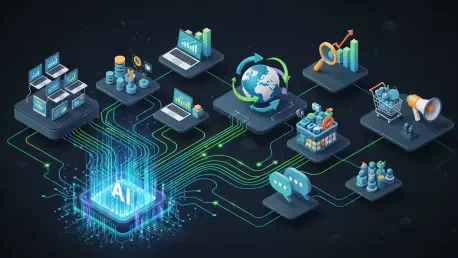

The rapid assimilation of artificial intelligence into the global marketing landscape has effectively obliterated the boundary between experimental technology and essential corporate infrastructure for brands of every scale. In the current environment, artificial intelligence is no longer viewed as a peripheral automation tool but rather as the foundational engine driving the entire lifecycle of customer engagement and content creation. As the cost of entry for sophisticated technology continues to decline, businesses are leveraging machine learning and predictive analytics to dismantle traditional barriers that once limited complex data analysis to only the largest enterprises. This shift represents a fundamental reimagining of how marketing teams operate, invest, and deliver value to an increasingly digital-first audience. By examining current trends and market data, it becomes clear that the transformation occurring within the industry is both profound and permanent, setting a new standard for competitive efficiency.
Modern marketing strategies have moved past the era of broad demographics and manual segmentation, which historically led to inefficient spending and repetitive, impersonal messaging. This evolution is rooted in the progression of data processing and the necessity for hyper-personalization in a crowded digital marketplace. The introduction of natural language processing and predictive modeling changed the core dynamic of brand interaction, allowing for the analysis of vast datasets to forecast consumer behavior with unprecedented accuracy. These foundational shifts paved the way for the current era of generative and agentic systems capable of real-time optimization. Understanding this background is vital because it explains why artificial intelligence is now considered core infrastructure; the transition from static, human-managed campaigns to dynamic, algorithmic systems is the culmination of decades of progress in computational sophistication.
Strategic Investment and Global Market Expansion
The financial commitment to artificial intelligence highlights its transition from a secondary experiment to a central pillar of corporate strategy. Data indicates that the global marketing market for these technologies is projected to reach a staggering $82.23 billion by 2030, reflecting a consistent growth trajectory characterized by a compound annual growth rate of 25%. This expansion is not merely theoretical; it is mirrored in internal company budgets where specialized solutions now account for an average of 28% of total marketing technology spend. Leadership teams are doubling down on this trend, with 71% of Chief Marketing Officers planning to invest at least $10 million annually through 2027. These figures suggest that the “wait and see” period has concluded, as companies that fail to allocate significant capital to these technologies risk falling behind in an increasingly automated and efficient marketplace.
The Evolution of Operational Workflows: From Task to Agent
Beyond high-level investment, the integration of intelligent systems is fundamentally altering the day-to-day operations of marketing departments across the globe. Currently, 88% of organizations report regular use of these technologies in at least one business function, marking a significant jump from previous adoption cycles. The focus has shifted sharply toward productivity and innovation, with 83% of marketers reporting a direct increase in output since adopting these tools. However, a distinct gap remains between simple experimentation and full organizational implementation. While 71% of leaders utilize generative tools regularly, only 32% of organizations have fully embedded them into their end-to-end workflows. This disparity represents a major opportunity for firms to move past simple content drafting and toward agentic systems capable of executing complex tasks, such as adjusting live ad campaigns or triggering automated customer journeys.
Navigating the Human-Tech Intersection: Trust and Transparency
As technology becomes more prevalent, the relationship between digital tools and human oversight is being redefined by necessity. One of the most critical challenges identified in recent market studies is the “leadership trust gap,” where only 31% of individual contributors believe their managers are truly knowledgeable about the tools they are implementing. This internal skepticism is mirrored by external consumer sentiment; 53% of customers express distrust toward search results powered by algorithms, and 68% state that technological advances make it even more important for brands to be transparent and trustworthy. To combat this, many high-performing teams are adopting the “30% rule,” ensuring that while machine systems handle the bulk of data processing and drafting, at least 30% of the work—specifically strategic oversight and final creative polishing—remains human-led. This balance is essential for maintaining brand authenticity in a marketplace saturated with generated content.
Regional Variations and the Democratization of Creativity
The impact of these technological shifts is not uniform across all sectors, as different regions and organizational sizes adopt tools at varying speeds. We are entering an era of “democratized creativity,” where it is estimated that by the end of next year, two-thirds of all generated marketing content will be produced by employees outside of centralized creative teams. This decentralization allows for faster iteration but requires new regulatory and brand-safety frameworks to ensure consistency across entire organizations. Furthermore, the rise of open-source tools is leveling the playing field; 51% of decision-makers at companies using open-source models report a positive return on investment, compared to 41% at firms relying solely on proprietary, closed-loop systems. This trend indicates that the ability to customize and own the underlying technology is becoming a key differentiator for success in diverse global markets.
Emerging Trends and the Rise of Machine Customers
The future of marketing is increasingly autonomous, characterized by the rise of “machine customers” and sophisticated personal assistants that act on behalf of the consumer. It is estimated that by 2027, autonomous buying assistants will generate 25% of total revenue for forward-thinking organizations, as 50% of people in advanced economies begin using personal agents for daily product discovery. This shift will likely lead to a 30% reduction in traditional display advertising budgets as consumers move away from standard search engines toward conversational interfaces. This change forces a pivot in how brands manage visibility; the focus is shifting from search engine optimization toward Large Language Model Optimization, ensuring that product data is structured in a way that algorithmic agents can easily digest and recommend to their human users.
The move toward these autonomous systems also impacts how marketing teams analyze performance and report results. Approximately 47% of marketing leaders report significant benefits from using generative systems for campaign evaluation and reporting, allowing for real-time pivots that were previously impossible. Furthermore, as Gen Z consumers continue to favor chatbots over traditional search engines—with 31% already making this transition—the demand for instantaneous, conversational brand interactions will only intensify. This trend suggests that the era of the static website is drawing to a close, replaced by dynamic, AI-driven hubs that adapt to the specific needs of each visitor. Economic pressures and budget constraints are also playing a role, with 59% of CMOs reporting insufficient budgets, which further incentivizes the use of automation to drive productivity gains and bridge the resource gap.
Strategic Implementation: Best Practices for Market Leadership
The statistics clearly demonstrate that these technologies are no longer an optional upgrade; they are the new standard for operational efficiency and competitive advantage. To succeed, businesses should move beyond simple task-based automation and focus on deep workflow integration that connects data across the entire organization. Actionable strategies include the implementation of dynamic customer segmentation, which allows lists to update automatically based on changing consumer behaviors like “high spending potential” or “at-risk” status. Furthermore, leveraging predictive analytics to determine optimal message timing can significantly increase engagement rates by ensuring communications reach customers exactly when they are most likely to interact. High-performing teams are already using these tools to personalize experiences across an average of six different channels simultaneously.
Another critical strategy for maintaining visibility in the modern market is the proper structuring of product data for discovery by intelligent agents. By using tools to scan and audit product pages for structured data gaps, brands can ensure they remain visible as search behaviors shift toward conversational models. Additionally, turning these technologies into internal analysts can save hundreds of hours of manual labor; requesting complex regional reports or top-selling product insights through natural language queries allows marketing teams to focus on strategy rather than spreadsheet manipulation. For professionals in the field, the path forward involves bridging the knowledge gap between executive vision and ground-level execution, ensuring that technology enhances rather than replaces the human empathy required to build long-term customer loyalty and trust.
Reflections on the Technological Shift and Next Steps
The transformation of the marketing sector through the integration of artificial intelligence was characterized by a rapid move toward efficiency, data-driven decision-making, and unprecedented personalization. Market data underscored a significant pivot where 28% of technology budgets were dedicated to automated solutions, and 88% of firms normalized the use of machine learning in their daily operations. The analysis revealed that while the financial investments were substantial, the true success of these initiatives often hinged on overcoming the trust gap between leadership and staff. Consumer behavior also shifted significantly toward conversational discovery, forcing brands to rethink their traditional advertising models and focus more on visibility within algorithmic search summaries. This period was defined by the realization that automation was not merely a cost-saving measure but a necessary component for survival in a high-velocity digital economy.
Moving forward, businesses must prioritize the ethical and transparent deployment of technology to rebuild consumer confidence, as 68% of customers now demand higher standards of brand trustworthiness. The next phase of development will likely involve the refinement of agentic systems that can operate with greater autonomy while still adhering to strict brand-safety protocols. Organizations should focus on training employees to act as “AI orchestrators” who can manage a fleet of specialized agents across content creation, data analysis, and customer support. By moving away from centralized creative silos and toward a democratized model of production, companies can maintain the agility needed to respond to market changes in real time. Ultimately, the long-term winners in this landscape will be those who master the balance of algorithmic power and strategic human oversight to create authentic connections with a more sophisticated consumer base.